Edward Hopper Nighthawks I Did It Again
Imagine you are standing on a urban center street corner, late at night. Yous peer into the window of a diner and see four people within. Maybe you feel less alone knowing at that place are other dark owls out there, or in this example, Nighthawks. This is the title of the painting by the American realist creative person Edward Hopper, which we will discuss in this commodity.
Tabular array of Contents
- 1 Artist Abstract: Who Was Edward Hopper?
- 2 Nighthawks by Edward Hopper in Context
- 2.one Contextual Analysis: A Brief Socio-Historical Overview
- 3 Formal Analysis: A Cursory Compositional Overview
- 3.one Subject Matter
- three.2 Colour and Light
- 3.3 Perspective
- 4 A Question Left Unanswered
- 5 Oft Asked Questions
- 5.1 Why Is the Painting Called Nighthawks?
- 5.ii What Is the Nighthawks Painting Value?
- 5.3 Is the Nighthawks Painting Based on a Real Place?
Creative person Abstract: Who Was Edward Hopper?
Edward Hopper was built-in in 1882 in a town called Nyack in New York, United states. He was artistically inclined from a immature historic period, around five years old. He started drawing sketches and in his teenage years, and used mixed media similar oil paints, charcoal, pen-and-ink, and watercolors. He was a student at the New York School of Fine art and Design.
His art teachers included William Merritt Chase, who also inspired Hopper's earlier art style. Hopper was also inspired by the styles of Édouard Manet and Edgar Degas, all figures from the French Impressionism art movement. Hopper married Josephine Nivison in 1924 who fabricated a meaning bear on on his piece of work and life.
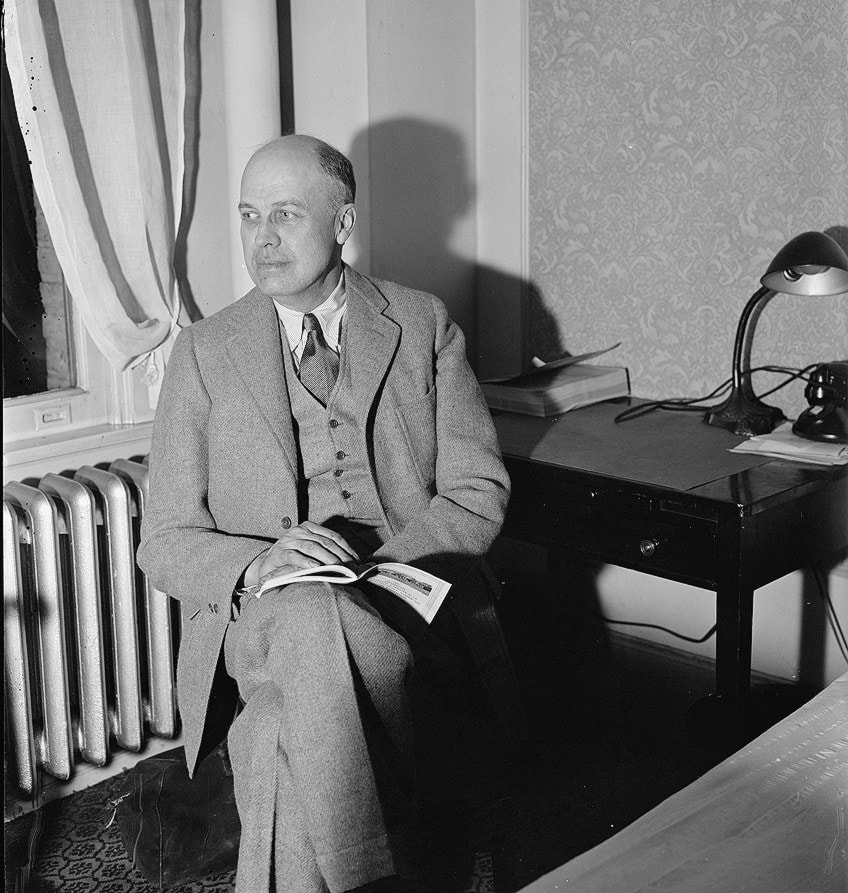 A portrait of Edward Hopper in 1937;Harris & Ewing, photographer, Public domain, via Wikimedia Commons
Nighthawks by Edward Hopper in Context
Known as one of the more than popular, and widely reproduced, American oil paintings from the Modern 20th-century art is Nighthawks (1942) by Edward Hopper. Often described equally a "timeless" painting, it depicts an every day – or every dark – scene of iv people in a diner. This is something almost everyone tin relate to, just this painting touches on deeper meanings than a diner countertop.
In this commodity we will explore a brief contextual analysis, we will provide some historical context of how this work is function of the American Realism movement and what may have influenced Hopper to pigment information technology.
Next, we will look at a formal analysis and Hopper'due south artistic style in this painting, for case, the way he utilized color to describe light and dark, his use of line, and of course, the bailiwick thing – just what are we looking at when nosotros see four people sitting in a diner in New York City? Below we look at all these and more.
| Artist | Edward Hopper |
| Date Painted | 1942 |
| Medium | Oil on canvas |
| Genre | Genre painting |
| Period / Movement | American Realism, Social Realism |
| Dimensions | 84.1 x 152.4 centimeters |
| Series / Versions | Not applicable |
| Where Is It housed? | Art Institute of Chicago |
| What It Is Worth | Sold in 1942 for $3000 |
Contextual Analysis: A Cursory Socio-Historical Overview
If we expect at the yr and location that Edward Hopper painted Nighthawks, which was 1942 in America, specifically New York every bit this was where the artist lived, we will discover it gives united states more contextual analysis well-nigh the impact of this painting. Go on all these points in mind before we look at this famous diner painting.
World War 2 was in full swing during 1942 and 1941 was the year when Japan bombed Pearl Harbor. To prevent aircraft bombings American cities likewise practiced blackout drills, which consisted of cities dimming or switching off most of their lights to minimize the extent of becoming a target.
This time undoubtedly impacted all Americans and left them feeling a sense of uncertainty and fear about their lives and the issue of the War.
Although this was not the sole reason for why Edward Hopper painted Nighthawks, it is an of import consideration to bear in heed when looking at his painting as it is depicted with a sense of quiet, dimness, and eeriness that can hands be attested to the prevalent mood of that fourth dimension, which was undoubtedly i of foreboding.
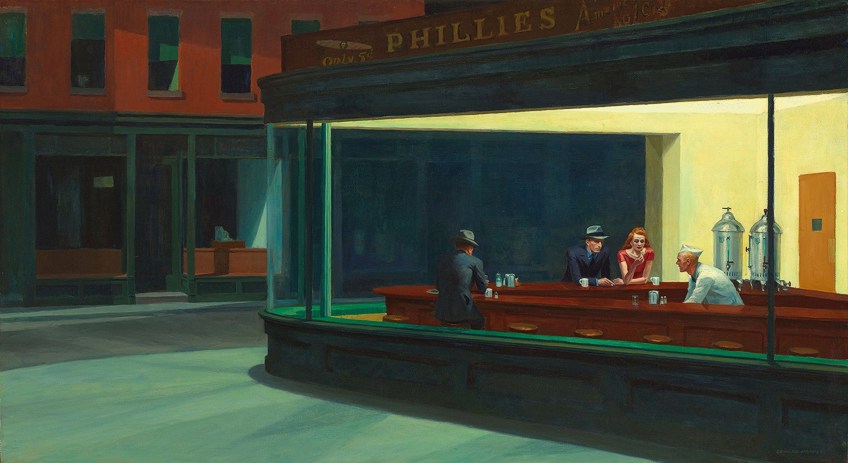 Nighthawks (1942) by Edward Hopper;Edward Hopper, Public domain, via Wikimedia Commons
New York during the 1940s was a bustling urban center total of life and development. The urbanized city life in New York was also a common way of life with thousands of people living in neighborhoods and apartment blocks going virtually their business. Nosotros cannot help only wonder what peoples' lives were like during the 1940s – was it similar today?
If anything, we can approximate that living in a big city similar New York had, and still has, its upsides and downsides whether you are alone or non. What was the existential quality for an inhabitant of New York, especially someone who lived during a fourth dimension of rapid modernization in culture and engineering science?
A Flake More than Nigh Hopper
Hopper was born and grew up in the small hamlet of Nyack in New York and moved to Greenwich Village in New York Urban center in 1913 where he stayed for the rest of his life. He worked as an illustrator for a large office of his career in New York City and sold his first painting titled Sailing (1911) in 1913 at the Armory Show in New York; he only sold other paintings years afterwards.
He made three trips to Europe before he settled in Greenwich Village and slowly developed his career as an creative person. He visited cities similar Paris and Amsterdam and experienced what fine art was like at that place.
During his fourth dimension in Paris, Hopper was notably influenced by the Impressionists, namely by artists like Édouard Manet, Edgar Degas, Pierre-Auguste Renoir, Camille Pissarro, among others and how they painted scenes of modern life living in the metropolis. Hopper besides reportedly painted street scenes during his visits in Paris, a style called en plein air, which means "in the open up air"; he as well painted from live models.
Hopper was also moved by Rembrandt van Rijn's The Night Sentry (1642) housed in the Rijksmuseum in Amsterdam. Hopper is reported to have said the following about Rembrandt's The Nighttime Spotter painting: "[information technology is the] most wonderful thing of his I have seen, its past conventionalities in its reality – it most amounts to deception".
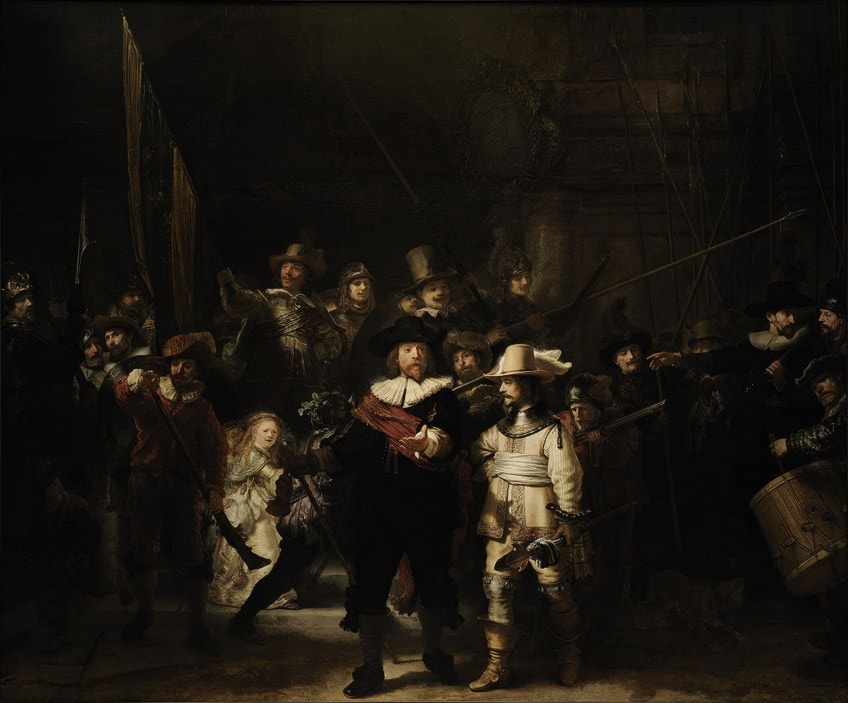 The Dark Sentinel (1642) by Rembrandt van Rijn; Rembrandt, Public domain, via Wikimedia Commons
Hopper loved his time in Paris and considered it ane of the most beautiful cities in the earth. He too considered himself an Impressionist throughout his career. Although he has primarily been categorized every bit an American Realist painter, he was also fatigued to the realist genre of painting.
Hopper was too influenced by Charles Meryon, who was a famous French engraver and well-known for his Gothic way of etches of Paris.
Hopper's painting procedure was obviously very slow, and it took him considerable time to find the right discipline matter. He is as well reported to accept stated that his painting "crystalized" when he started printmaking in 1915. His etchings were notably mysterious in their mood, a adept example of this is his Night Shadows (1921), which depicts an aerial view of a solitary figure walking on a street corner in New York.
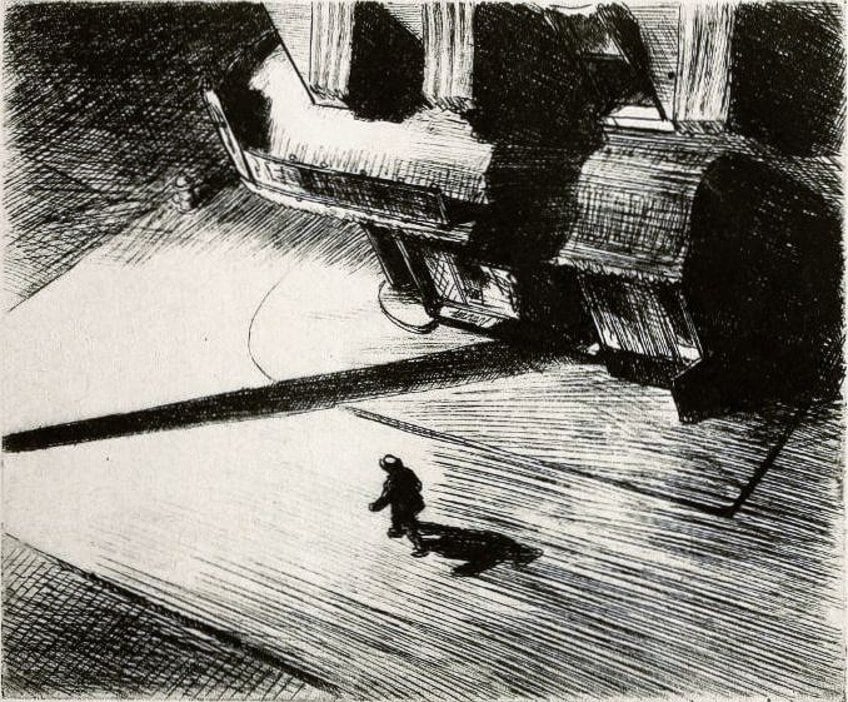 Nighttime Shadows etching by Edward Hopper, 1922;Edward Hopper, Public domain, via Wikimedia Eatables
This shadowy-based style was as well influenced past film noir during the 1940s. Films and theatre were important parts of Hopper's life and ultimately his art way. He loved watching films and visiting theatres, in fact, his teacher from the Ashcan School, Robert Henri, motivated him to do this to likewise observe life and people effectually him.
Hopper is reported to have said, "When I don't feel in the mood for painting, I get to the movies for a calendar week or more. I go along a regular movie rampage".
It was in 1923 when Hopper and Josephine Nivison met each other over again, previously they met through Robert Henri as students. The two concluded upwards marrying in 1924 and would exist together for the rest of their lives.
During the 1930s Hopper's artistic career started flourishing, he sold around thirty paintings and around 18 watercolors to prominent art museums like the Metropolitan Museum of Art and the Whitney Museum of American Art. The Museum of Mod Art exhibited a retrospective of Hopper's piece of work during 1933 after accessioning his painting House by the Railroad (1925) equally part of their permanent drove in 1930.
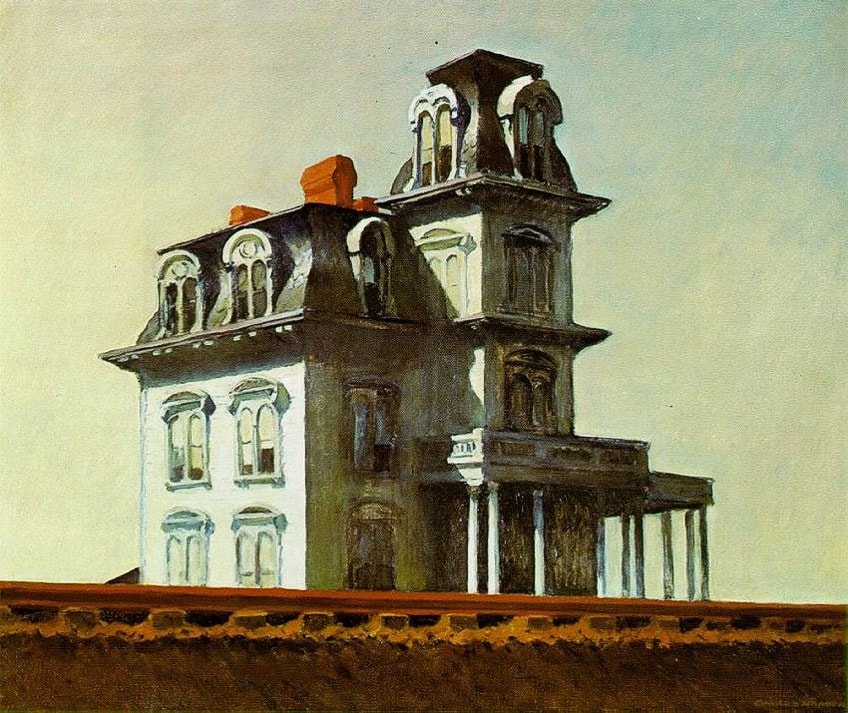 House past the Railroad (1925) past Edward Hopper;Edward Hopper, Public domain, via Wikimedia Commons
Hopper certainly received artistic recognition and acclaim during the 1930s all the way to the 1960s from the years of struggle and seemingly uneventful artistic career. He continued to create paintings with the characteristic theme of solitary figures amidst various urban landscapes, oftentimes with an open up-ended narrative, leaving it up to u.s.a., his viewers, to determine the outcome of his painted characters.
Jo and Edward are described as having lived a "frugal" lifestyle and would spend their money on movie or theatre tickets and eating out at inexpensive diners. The couple likewise traveled to various places like New England where they would stay and paint, including their firm in South Truro in Massachusetts.
The couple was known to have a difficult relationship, but, nonetheless, Jo was Hopper'south model for his paintings and gave his artistic career a boost in many ways. Hopper was also known as an introvert and did not find social aspects of life easy to handle. He lived very inwardly, a lover of art in all forms, painting, literature, and moving picture.
He was a conscientious artist, and, with Jo'south input, his paintings were extensively planned earlier their execution, much similar the fragile planning that goes into directing a movie.
Formal Analysis: A Cursory Compositional Overview
Beneath we zoom in on Hopper's acclaimed painting Nighthawks (1942). We will explore its subject matter and some of the stylistic elements Hopper employed in its creation, particularly his use of lighting and perspective.
Field of study Affair
In Hopper's Nighthawks painting nosotros run into a diner with four people inside, on what appears to be a street corner. There are 3 men and one woman, of which Hopper and his married woman Jo were the main models. Surrounding the diner are other apartment buildings reminiscent of a street in New York City. The scene takes identify during the night with no other sign of life other than the 4 figures inside.
Although this scene appears very simplified and solitary, there are detailed props and cues that requite us a scene filled with life.
Let united states start with the diner. There is no door indicated for the diner, the simply door we see is the one inside that appears to be the kitchen door. The windows almost become an enclosed frame for the four figures inside, leading our attention to them. Furthermore, the diner is the merely source of low-cal also lighting upward the pavement outside, further highlighting the figures inside.
Higher up the diner, we see an advertizement, or possibly the name of the diner, that says, "Only 5c Phillies". The residue of the advertizement words are partially cut off by the composition, but it appears to read "America's No 1 Cigar".
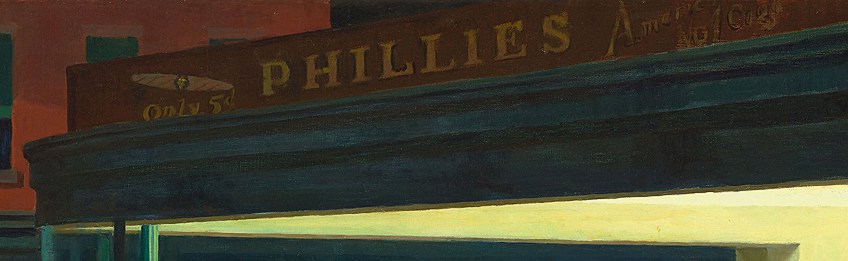 A detail of Nighthawks (1942) past Edward Hopper;Edward Hopper, Public domain, via Wikimedia Commons
The Four Night Hawks
In that location are four figures inside, three sit effectually the wooden countertop, which takes upwards nearly of the space inside the diner and appears almost triangular in its shape. The waitron, who wears a white uniform and hat, is on the inside of this space, behind the counter. He is looking alee at something with his rima oris partially open up in a grimace of some sort decorated with something backside the counter.
He is the merely figure out of the iv with a more animated facial expression.
There are two figures sitting next to each other on the other side of the counter opposite the waitron. From our view, the woman sits on the correct and the man is next to her (our left). She has reddish-brown colored hair, wears a ruby-red blouse, and holds up what is possibly a sandwich in her right manus (our left). The man next to her wears a steel gray hat with a navy conform and necktie, a light blue shirt underneath, and a cigarette in his right hand (our left), his hands resting on the countertop.
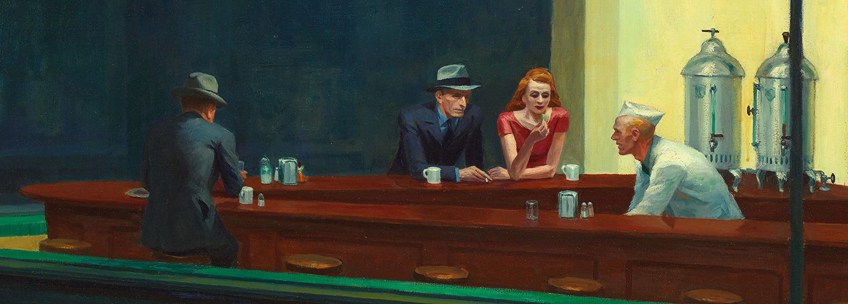 A detail of the figures in Nighthawks (1942) by Edward Hopper;Edward Hopper, Public domain, via Wikimedia Commons
Although these two figures are sitting closely next to 1 some other they appear to exist worlds apart. Their left hands (our right) are both resting on the countertop and at first glance, it would appear they are touching, but if you look closer, there is no intention for their hands to connect despite the physical closeness; both appear deep in thought or perhaps simply a general malaise?
The other figure sits on the other side of the counter with his dorsum to us. All we know most this figure is that he wears a similar hat to the other homo and a dark-colored suit. He holds a glass in his right hand and in that location appears to exist a folded paper resting under his left elbow. He sits on the second bar stool from the outer edge of the counter; there are seven bar stools along the counter.
The Props
The diner seems to be the chief focal point of the Nighthawks painting, just it would somehow not have the same touch without the props surrounding the four figures. If we wait at the countertop, we run across the meticulous attention to detail in the coffee cups, glasses, napkin holder, and salt and pepper shakers.
There is also an extra glass near the fifth stool of the counter – who does this belong to?
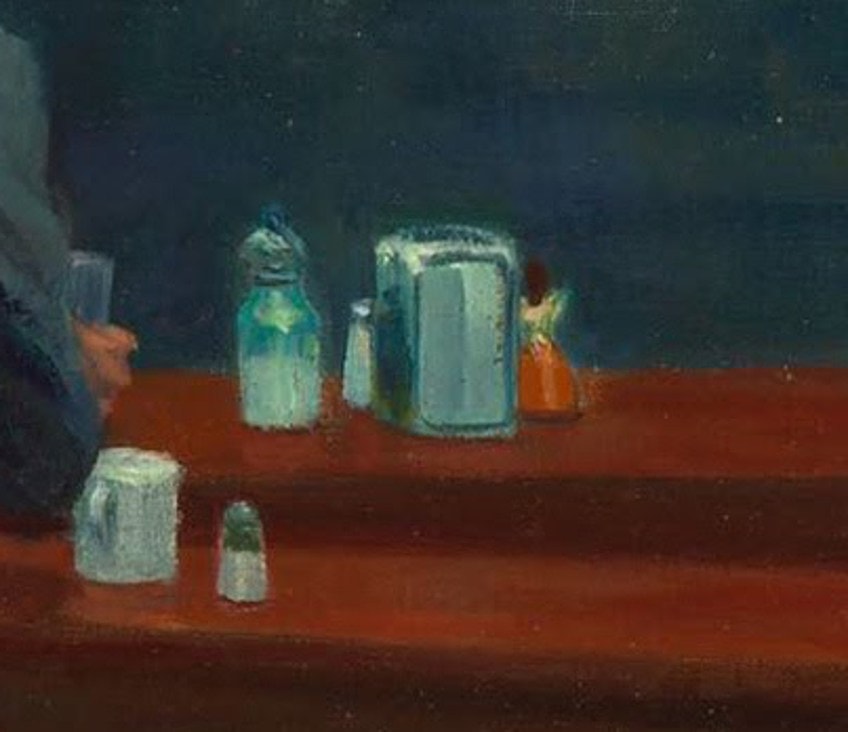 A detail of the props in Nighthawks (1942) by Edward Hopper;Edward Hopper, Public domain, via Wikimedia Eatables
Almost the kitchen door to the far-left corner inside the diner, the merely corner nosotros can visibly see inside the diner, we also observe 2 large silver coffee urns including how much coffee is in each; the left urn appears to be on empty and the right urn has about a third of java left in it.
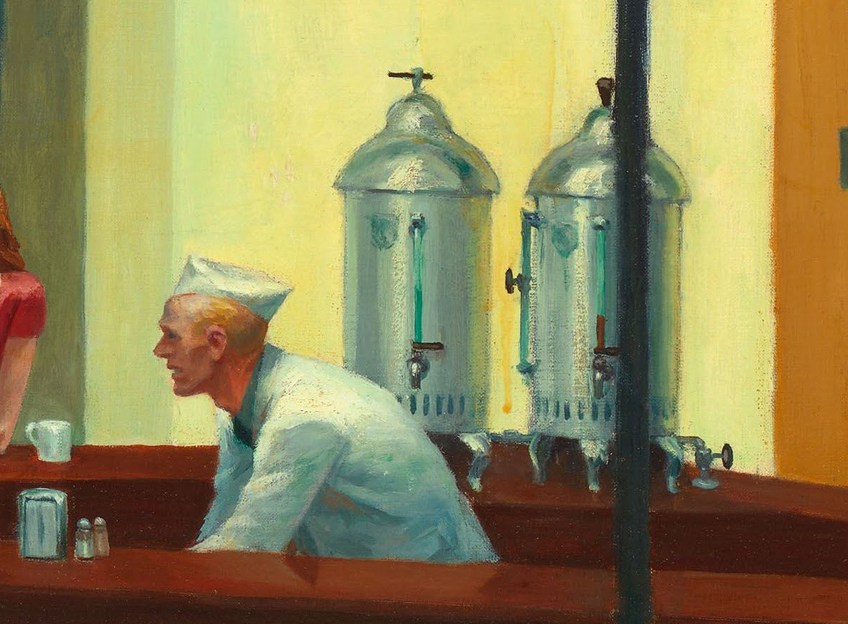 Another particular of the props in Nighthawks (1942) by Edward Hopper;Edward Hopper, Public domain, via Wikimedia Eatables
The setting outside the diner is darker, the interior spaces below and above in the building across the street are all airtight indicating no calorie-free or life. All we come across through the windows inside the space below is a cash register on a wooden counter, suggesting information technology is a shop. Above, the forest-greenish blinds of the vertical-rectangular windows appear half shut.
Colour and Calorie-free
Edward Hopper utilizes color to depict ambient light in the Nighthawks painting, nosotros encounter this primarily in the fluorescent lite in the diner, which was a popular and new type of lite form during the 1940s. This light seemingly works like a spotlight on the primal figures, most equally if information technology is a low-cal on a theatre stage highlighting the main characters.
The yellowish ceiling makes the calorie-free but a little warmer.
Furthermore, if we zoom in on the figures' skin tones, we come across the effects of the light, which gives them a "washed out" await. The light moves onto the pavement exterior, illuminating the surrounding expanse, simply as nosotros motility farther into the street, it becomes darker suggesting more lifelessness effectually the diner.
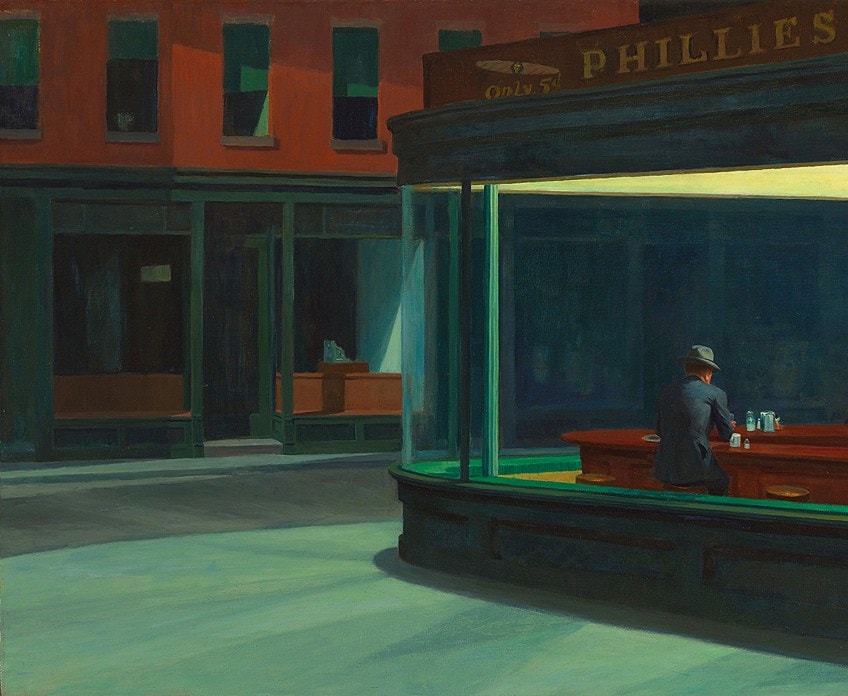 The lighting in Nighthawks (1942) past Edward Hopper;Edward Hopper, Public domain, via Wikimedia Commons
Additionally, we practise not see any other class of light other than the diner light, which also reaches its way into the shop beyond the street and some of the windows to a higher place it. Hopper depicted light in a realistic style – this is something we would run across if we were continuing on a darkened street corner looking in on an illuminated diner.
Depicting low-cal was one of Hopper's goals and loves. We see this not but in the way he depicts artificial man-fabricated light just sunlight too in many of his other paintings. Some include Rooms by the Sea (1951), Morning Sun (1952), and Second Story Sunlight (1960), among others.
He is remembered as saying, "I guess I'thousand not very human. All I really want to practise is paint light on the side of a firm".
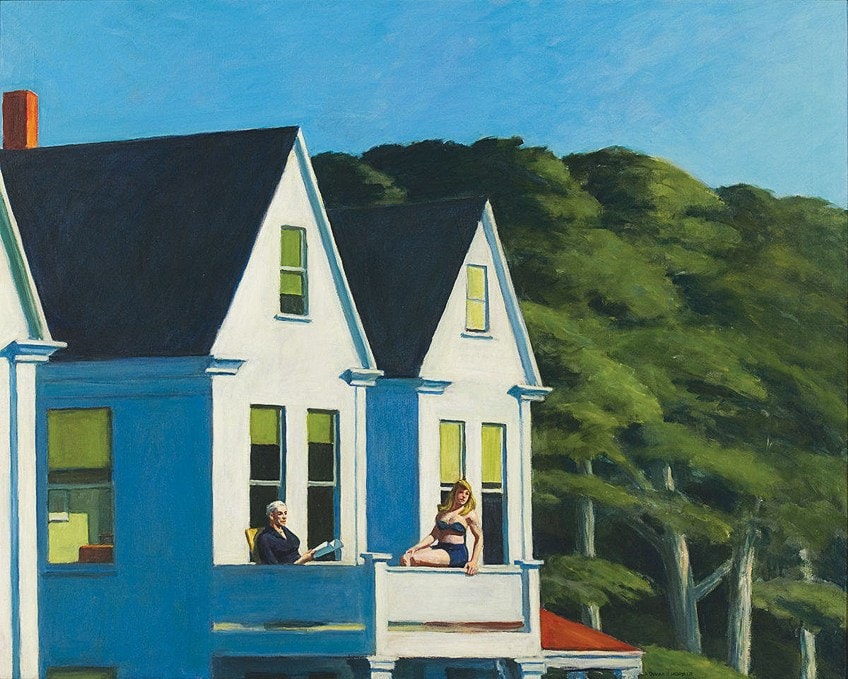 2d Story Sunlight (1960) by Edward Hopper;Edward Hopper, Public domain, via Wikimedia Commons
Perspective
The mode Hopper utilized perspective in his Nighthawks painting is significantly interesting and artistically astute. He created numerous preparatory sketches not only for the characters and props but besides for the compositional layout and perspective. Every bit noted before, the countertop inside the diner appears like a triangular shape, which echoes the triangularity of the street corner the diner is located on.
The unabridged diner is besides viewed from an angle through the perspective of an unknown viewer, which is presumably us; at that place is an element of voyeurism in the way Hopper depicted the Nighthawks scene. Furthermore, Hopper utilized the placement of horizontal and vertical lines to create a focal indicate, which is the diner.
If nosotros look at the diner to the right side of the composition, the horizontal lines from the pinnacle and bottom of the structure converge to a focal point somewhere in the distance to the left that we cannot see.
A Question Left Unanswered
The Nighthawks' painting value around 1942, the year information technology was sold to the Fine art Establish of Chicago, was $3000. It was reportedly sold a few months after it was completed in January of the same year. Hopper stated that the diner painting was "suggested by a restaurant on Greenwich Artery where 2 streets meet", even so, this diner has been widely searched for as a location.
Furthermore, this famous diner painting has been the inspiration for modern-day pop culture, from movies, literature, paintings, and many other artistic modalities. For instance pop Tv series like The Simpsons, CSI: Crime Scene Investigation, Joyce Ballad Oates' verse form titled Edward Hopper's Nighthawks, 1942, the music album titled Nighthawks at the Diner (1975) by Tom Waits, and many others.
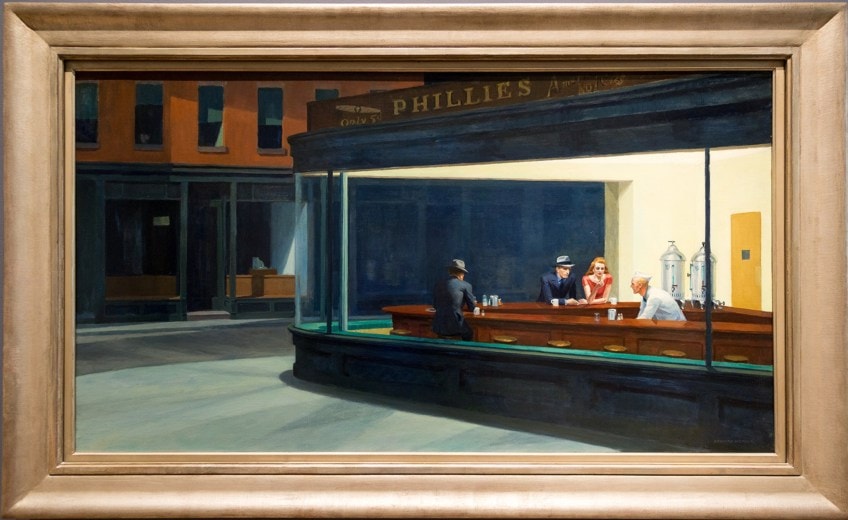 Edward Hopper's Nighthawks (1942), housed at the Art Plant of Chicago; Edward Hopper, Public domain, via Wikimedia Commons
The master "buzz words" around this painting include timelessness and loneliness because information technology shows u.s.a. the realities of living in a city brimming with culture and people, yet the other side of it can leave 1 feeling completely isolated in its throes. Hopper ironically did not solely aim to depict this aspect; he was reported as saying, "unconsciously, probably, I was painting the loneliness of a large city". Nosotros tin can believe this equally he lived in the urban center and must have felt similar feelings.
Hopper depicted a scene so empty that it was filled with potential, this potential has been explored by so many in the form of figuring out what the scene ways and creating stories for the four characters. In that location have been many attempts at answering the inevitable questions that accompany this painting, namely, who are the people in this painting, where do they come up from, and where are they going? A question Hopper left unanswered – a question he left on the table for u.s. to answer.
Take a look at ourNighthawkspainting webstory here!
Frequently Asked Questions
Why Is the Painting Chosen Nighthawks?
Nighthawks by Edward Hopper was given its name because of the abrupt shape of the man'due south nose sitting side by side to the adult female. His nose resembles that of a bird's neb, and it was suggested by Jo Hopper (Edward Hopper'southward married woman) that "Nighthawks" would exist a practiced proper name for the painting.
What Is the Nighthawks Painting Value?
The Nighthawks painting value was $3000 in 1942, the year information technology was sold to the Art Plant of Chicago for the in a higher place price and only a few months after its completion. However, the value of this painting has undoubtedly increased since the 1940s.
Is the Nighthawks Painting Based on a Real Place?
A widely searched diner, Hopper stated that the diner painting was "suggested by a eating house on Greenwich Artery where two streets run across". However, it is believed that this diner was based on diverse diners.
Source: https://artincontext.org/nighthawks-edward-hopper/
0 Response to "Edward Hopper Nighthawks I Did It Again"
Post a Comment