What Are the Best Residential Houses at Dartmouth
Dartmo.
The Buildings of Dartmouth College
Dominicus'southward postal service asked what happened to the "swing space" dorm proposed for Crosby Street. Professor Nyhan, quoted in an article in The Dartmouth, 1 Parker O'Hara, "New undergraduate housing on Lyme Road to break ground by end of year," The Dartmouth (25 Jan. 2022), available at https://www.thedartmouth.com/article/2022/01/new-undergraduate-housing-on-lyme-route-to-break-ground-by-end-of-twelvemonth. pointed out the availability of the Crosby Street site. Now Ben Korkowski of The D has an explanation, quoting V.P. for institutional projects Josh Keniston:
"Information technology is a tough site to build on: There is a steam line that runs through information technology, the Onion and tennis courts are there and information technology is a relatively tight infinite," Keniston explained. 2 Ben Korkowski, "New residence hall set to supercede the Onion placed on indefinite suspension," The Dartmouth (27 Jan. 2022), bachelor at https://www.thedartmouth.com/article/2022/01/new-residence-hall-set-to-replace-the-onion-placed-on-indefinite-pause.
The housing crisis of the moment does seem to have a lot to do with the long-term decision to throw upwards a hasty plastic dorm off campus.
Let's say the Crosby Street swing space takes two years longer to build than the school-jitney dorm on Garipay Fields will take. Wouldn't it be amend to put up some Tree Houses in Maynard Yard and on the Gilman site for a few years while edifice on Crosby Street so stop up with a real, permanent brick dormitory at the center of campus?
The planning effort for the Lyme Road Southward precinct now has its ain project page and has a serious team behind it:
Projection Manager: Joanna Whitcomb
Planner/Architect: Beyer Blinder Belle
Landscape Builder: Michael Van Volkenburgh Associates
Ecology Blueprint Consultant: Atelier Ten
The planners have sent out a Love Neighbors newsletter (pdf) letting the neighbors know that a dormitory cluster — a group of "apartment-fashion" residences for 300 students, presumably seniors — is planned for their area.
Included in the college's report of concluding Thursday's community meeting is a map showing the site of the proposed cluster. The site is south of or upon Garipay Fields, southwest of the Rugby Order and presumably encompassing the driving range of the old HCC Practise Area:
That site is much further away from campus than, say, the Dewey Field Parking Lot, itself a barely acceptable site for a remote new dorm.
Google Maps says it takes 20 minutes to walk from Bakery Library to the driving range southward of Garipay Fields.
The proposed dorms will exist used as swing infinite during a menstruum of at least x years equally existing dormitories on campus are renovated. After those renovations are complete, one hopes that the college will plow over the apartments to graduate students rather than expanding undergraduate enrollment to fit the available housing. Perhaps that ability (and commitment?) to abandon the dorm afterward its apply past undergrads is the only thing that could make the program acceptable.
Taking a piecemeal approach to the expansion of existing dorms (mentioned in this postal service) would certainly exist meliorate for the campus than erecting a distant, school-bus dependent cluster on Lyme Road. Even building a single 300-bed swing space cluster at the corner of Maynard and Rope Ferry would seem far superior to the Lyme Road idea. Once the 10-year renovation project is completed, that swing space can go a combination of offices and graduate pupil housing — only every bit Hunt and Woodbury Halls at Tuck and 37 Dewey Field Road were all converted from housing to offices. (And whatever happened to the "swing space" dorm proposed for Crosby Street? Wouldn't information technology obviate the need for the Lyme Road projection?)
It seems that folks are in a bustle, and a grassy, vacant site allows for hastier construction.
——————-
Update 01.24.2022: The Valley News has an article on neighborhood opposition.
Dartmouth News and the Valley News study on the higher'southward involvement in developing the land n of the Life Sciences Edifice, including parts of the golf course. The possibility of such evolution was spelled out in the master plan some fourth dimension ago, simply the noteworthy new detail is that the college is because building dormitories on some part of the site.
First reaction to the dorm idea: This is an unserious proposal, a negotiating tactic, like the College Park dorm thought. It is a lightheaded idea. The ten-minute walking radius from Baker is not but a guideline, information technology is a crucial rule of campus composition. Plans for transit practice not eliminate the 10-minute walking radius, and it just does not seem appropriate to have students riding the schoolhouse bus to class in a place as small as Hanover.
Afterwards a closer expect: From Bakery Library to the Dewey Field parking lot site might exist a half-mile and take nine minutes to accomplish on foot, making it technically adequate. Information technology is about as far away as the River Cluster was — non an admirable standard, just a Dartmouth precedent. One hopes that the Dewey Field site is the only one they are talking near for a dorm, because any site beyond information technology would be unacceptable.
(What about the college-related buildings that are not part of the everyday life of students or faculty? Storage libraries and evolution offices and various dorsum-office functions would be perfect for the golf class sites. They would be much better sited here than in the sprawl of Centerra or in towns around the region.)
If not on Lyme Road, where could the increasing number of students be housed? (The proposed Crosby Street dorm will be ignored, considering it will be used as swing space to business firm students from existing clusters as they are renovated.) Hither are some available sites, some of them identified in the electric current chief plan:
- A 2nd Mass Row
- The Gilman site (offered in the College Park dorm siting word)
- The Maynard and Rope Ferry corner (or whatsoever site on any side of Maynard Yard)
Might it be the case that the number of additional students to be housed, say 350 students, would be too large to fit on ane of those sites? Yes. That is a good thing, both for Hanover's urbanism and for the students who end up living in the new hall. Instead of building a giant barracks, the school should add boosted beds to the existing campus at a combination of smaller sites within the ten-minute walking radius, including:
- Additions to and eventual replacement of the Choates
- An addition to Wheeler Hall
- A dormitory range on the outer edge of College Park betwixt RipWoodSmith and Andres
- A dormitory range due west or north of McLane Hall
Obviously these new additions will have to join existing house communities; in that location is nothing incorrect with that. Creating a subtle and sensitive serial of additions to historic buildings will be more expensive than dropping a single giant circuitous on a distant lot, but information technology will be worth it. It seems that the desire to add beds to the campus exclusively in the form of one entirely new house community at a time is driving the push to build dorms outside of boondocks, and information technology is harmful.
The college released the terminal (November 2020) version of the master plan (pdf) in July of 2022 (Anna Merriman, "Dartmouth master programme calls for growth along Lyme Route," Valley News (2 July 2021)). The plan is not getting enough press or enough praise, and so hither are some observations:
-
Equally noted earlier, the possibilities for growth in the key campus look great (page 38).
-
The north end opportunity sites are all super. Old Hospital Quad will be an incredible infinite 130 years in the making (pages 42-43). Fairchild Tower always did seem more than than necessary for its purpose; information technology is actually a signpost edifice (pages 44-45).
-
Putting student housing in Remsen-Vail might be touchy. If you wanted to reuse a ho-hum Sixties edifice equally housing, you lot should accept done information technology with the DHMC belfry. Remsen-Vail could be accordingly used for academic purposes, nevertheless (folio 44).
-
Lyme Road development is inevitable, but it is non clear how realistic it is to show such development without parking lots (pages 46-47).
-
When information technology comes to the Westward End, the novelty in this programme is the meander of the Cemetery Bridge (Thayer Viaduct). Information technology is more than like a boardwalk on a nature trail and does non appear to exist a interruption bridge at all — merely won't it be extremely difficult to put bridge footings in a cemetery? (Pages 48-49).
-
More on the Due west Stop: Again, the original Constrict School building hither could make an astonishing undergraduate dormitory, but one would detest to see Tuck School vanish into the suburbs (pages 48-49).
-
South End and Downtown: The athletics promenade between Lebanon St. and Thompson Arena is excellent and long overdue. It could be a fine linear piece of work of landscape architecture. Annexing Davis Varsity House equally a part of the "house customs" for the Crosby Street swing space dorm could be a superb move. The reasoning behind the focus on wellness for an expanded McKenzie is not clear — couldn't it be used for anything, including arts uses? — only information technology makes no divergence equally long as the building is saved. McKenzie might nowadays a real opportunity to create a new building within the historic brick walls (pages 52-53).
-
Quibbles are small-scale and basically the aforementioned as before: Thayer School didn't become from the one-time Experiment Station directly to the West Terminate in 1939, it spent several years in Bissell Gymnasium (page 9); the reference to "Sprint Hall" is kind of irritating (page 38); and it's "Bema" not BEMA (page 41).
-
The map on pages 28 and 29 showing named landscape opportunities is an important document. Some offhand proposals for these spaces:
Name in Plan Proposed Replacement Riverfront Park Leydard Park West Stop Dark-green A tough one; this was the Wigwam Circle postwar housing area. Tuck Greenish at the stop of Tuck Mall Tuck Circumvolve Dart Row Commons Fayer Greenish? "Eatables" is not really appropriate for an open up space. Maynard Yard Old Hospital Yard. This really is a better name. Life Sciences Backyard Another tough one; at that place is very fiddling historic context hither. North Terminate Light-green in a strip of Dewey Field Dewey Field. Another one that really is a amend name. Vox Lane NHCAMA; New Hampshire something; or State College something? "Voice Lane" has always been arbitrary, which is disappointing in this richly historic precinct. Park Street Gateway Piazza Nervi. This is tougher to justify now that grass rather than hardscape is proposed for this space.
As a site for the new dormitory (see the site search projection page), the college has picked the corner of Crosby and East Wheelock Streets (Valley News). That was the arguably the best location of the three in contention, and it was the only one that campus principal plans had previously designated for residential use.
The architect for the site selection is Sasaki, and that firm besides seems to exist the one signed upward to design the new dormitory. 1 might predict that folks will exist upset when they see the designs for a massive v-story, flat-roofed Modernist building betwixt Alumni Gymnasium and Topliff Hall. For groundwork, Sasaki designed Maria Hall at Regis College in Weston, Mass., the Wolf Ridge Apartments at N.C. State, and of course the temporary "firm center" social buildings at Dartmouth.
The college has been giving presentations (Valley News article) on the potential sites for a proposed 350-bed dorm. An initial list of four sites was reduced to three when College Park was dropped every bit a site for fifty-fifty this smaller version of the dorm. The iii remaining sites are the former site of Gilman, the current site of Dragon on College Street, and the current site of the tennis courts and the Onion on Crosby Street at East Wheelock.
The proposition on this site that scattering a few smaller additions effectually campus would be preferable to erecting a single 350-bed dormitory was based on the assumption that such a large edifice could non comfortably be shoehorned into a site as small as that on Crosby Street. Considering the fact that the entire McLaughlin cluster only contains 341 beds and has a footprint that is much too large to fit next to Alumni Gym, this assumption does not seem unreasonable.
The reason the college gives for the 350-bed number is the desire to use this swing infinite dorm to firm an entire "house community" at a fourth dimension. Fair enough — that is what Princeton did when it built Scully and Bloomberg Halls, initially planning the buildings to house a rotating cast of residents of other residential colleges as their own buildings were being renovated.
Adhering to the 350-bed goal volition require all of the proposed buildings at Dartmouth to stand four and five stories high, and the Crosby Street site volition require a building that stands five-and-a-half stories high.
At whatsoever rate, Sasaki (presumably) created a site plan and a massing study for each site and had Boston-area designer Dongik Lee depict up two perspective views of each potential building. These are nicely done and bear witness the same style of edifice in each location. They are introduced with the caveat that they are not actual building proposals merely are for illustration only.
Gilman and to a lesser extent College Street make sense every bit sites for some futurity building, just they exercise seem the lesser of the three sites for a new dormitory. College Street in particular begs to exist left as forest or to become a site for an addition to Shush, office of a unified scientific discipline complex 120 years in the making. (And amalgam a building on College Street would crash-land off the Dragon Hall for at least the third time).
The Crosby Street proposal, called "the Question Mark" because of its shape, seems the near popular among audience members. It is nearer to dining areas and has a site that is not more suitable for another apply.
The site has indeed long been reserved for residential use — the 1998 master plan (pdf p. xix) states that "[a]t 5 stories, two residences on this site could adjust 200 beds. Social and study spaces could be added to serve Topliff and New Hampshire [H]alls, also." Interestingly, the 2001 plan and its 2002 update (pdf p. 12) would let simply 160 beds here.
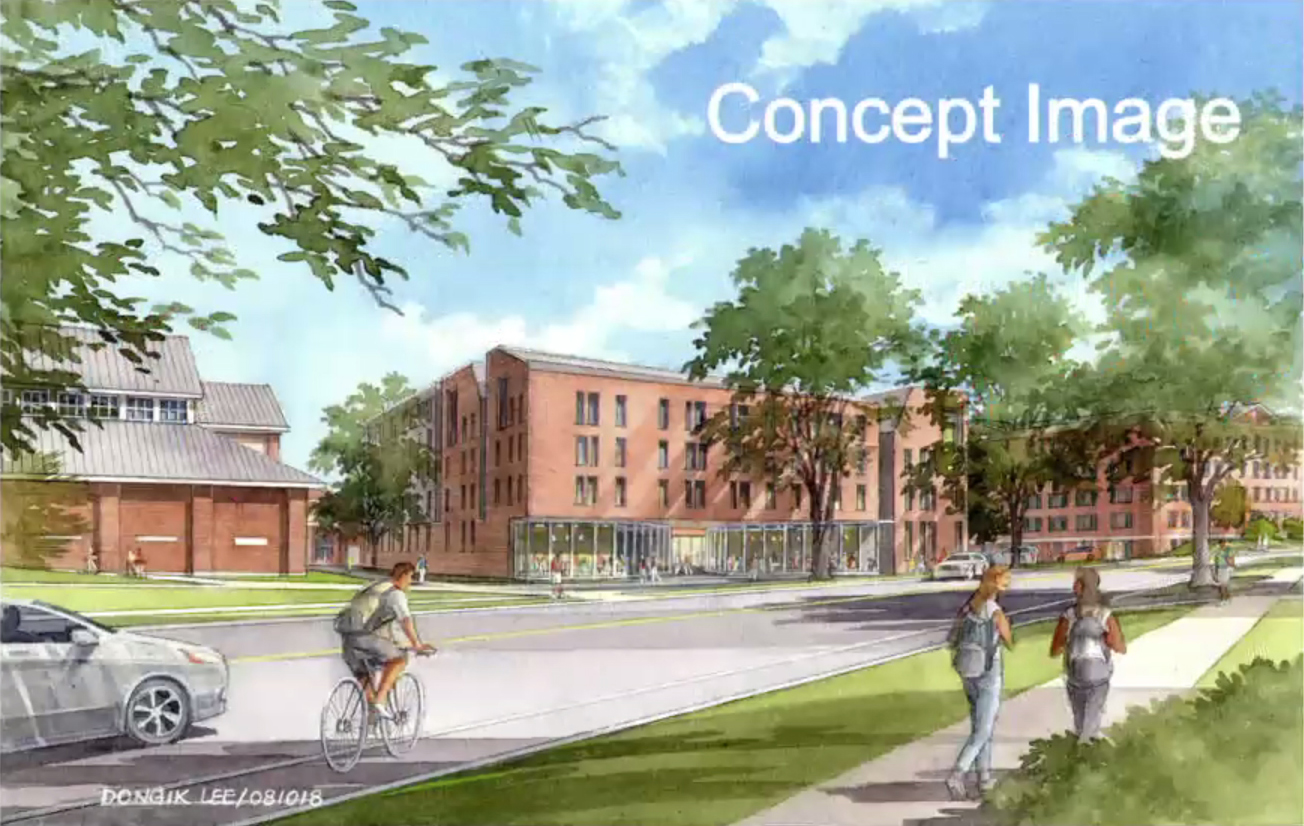
A dormitory on Crosby Street could make prissy companion to Topliff, which was the behemothic dorm of its own era. 1 hopes, however, that the building could be given a footprint that is big enough — and that extends far enough to the south — to reduce its peak somewhat. The driveway to Alumni Gym could be realigned to the south, and Davis Varsity House could be moved to face up Lebanon Street equally role of Larson Square, giving the new dorm more than infinite in which to spread out. And this is completely unrealistic, at least until a Southern Bypass is built, only wouldn't it be nice if Crosby Street could be partially or completely closed to traffic? That would be one way to brand more space.
The higher is holding advisory sessions in Filene to air some potential sites for a big, 350-bed dormitory cluster (Dartmouth News). "Following the three sessions, administrators volition select a preferred site and begin the design and evaluation phase of piece of work."
There is no discussion on how many sites will be on the menu. According to the Valley News, "[t]he college has not said publicly what sites are being considered, simply spokeswoman Diana Lawrence on Monday said they are all on campus and will be appear at the meetings" (Valley News). One would not have thought it necessary to country that all of the sites are on campus, just this is going to be a huge group of buildings, probable larger than the McLaughlin Cluster.
The demand for many new beds is difficult to dispute, especially if the Choates and the River are to be replaced. Just the programmatic case for putting all the beds on one site, equally opposed to splitting them among four or five buildings or additions to existing dorms, has however to exist fabricated. The college could be letting the goal of efficiency of construction management on a unmarried site get in the way of good campus planning. And the misguided attempt to keep everything together is also likely to encourage unnecessary demolition.
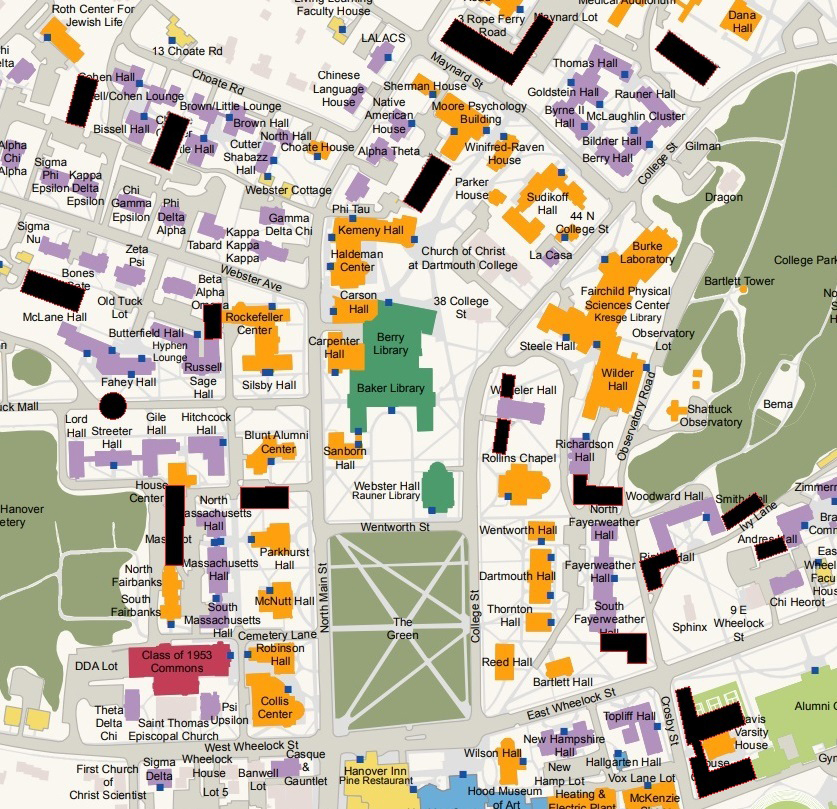
Hither is a very rough alternative suggestion of a few of the potential sites for dormitories of a reasonable size (basemap pdf):
-
Zippo is left of Gilman merely a hole in the ground (projection update).
-
Well that was odd. The Valley News reports that the NewVistas Foundation plan for a 20,000-person new town in Vermont has been abandoned.
-
The Valley News reports on the decline of "WinCycle, the Windsor nonprofit that for sixteen years has been taking discarded computers and electronic equipment from Dartmouth-Hitchcock Medical Eye and Dartmouth College, refurbishing information technology, and reselling the equipment[.]"
-
A lot of naming is going on. The Valley News reports on the DEN becoming the Magnuson Family unit Center, to exist located in the new Thayer building; the Grad School has been named for Frank Guarini '49 (Dartmouth News); and the college is offering a big donor the adventure to rename the Norris Cotton Cancer Center (Valley News). It did ever seem a piddling odd that the center was named for the legislator who wangled the federal funding to establish it.
-
The WRJ celebrated commune is expanding to include an expanse that an architectural historian calls Little Italia (Valley News). The Polka Dot volition be saved (Valley News).
-
The Hood staff are moving into the expanded museum, only the opening will non have place until 2022 (Dartmouth News).
-
Hey expect! The Dartmouth 250 logo has gone from four fonts to one, and that 1 is Dartmouth Ruzicka: Dartmouth 250.
-
The Valley News reports that Nick Zwirblia has written a novel, The Bramford Chronicles, Volume I: Johnny & Baby Jumbo. Y'all might know Mr. Zwirblia better as the Happy Hop Guy.
-
Rauner had an exhibit on the history of the Ledyard Canoe Club.
-
The Valley News business magazine, Enterprise, has an commodity on the Grafton County Farm, a government operation that once might have been called a "poor subcontract." Grafton County'due south is still operating.
-
The capital campaign confirms in a general way some building projects:the Dartmouth Hall renovations; the Hood and Hop expansions and renovations, totaling $125m; and residence hall construction including 356 beds worth of dorms for $200m. There is no give-and-take on whether the Hop expansion will follow what seems to be a smart pattern from 2013 by Bora Architects. There is also talk of a request for a $50m endowment for the six firm communities. One hopes that each business firm is endowed individually (starting at, say, $8m apiece) and is named past its benefactor.
-
The Dartmouth Hall renovation plan is based on an unusual pitch for funding past women (run into Inside Higher Ed). More than a century ago, the college targeted the somewhat-arbitrary classification of Massachusetts alumni as a funding source for a new dormitory.
-
Several campus buildings are getting solar panels on their roofs (The Dartmouth).
-
There was a lot of news last April nearly the shuttering of UPNE, the University Printing of New England (The Dartmouth, Within Higher Ed, Valley News).
-
Students are working on a new historical accountability project that volition focus on the office of slavery in Dartmouth'south founding and early on history (Dartmouth News).
-
On Tuck Drive, "[c]onstruction besides would add a sidewalk and cycle lanes to the road, which is about twenty-feet wide, Worden said" (Valley News). That is unfortunate. Information technology's difficult to come across how the celebrated granite curbing and guttering (not to mention the retaining walls) could be preserved if a sidewalk were added. Could the college apply a row of poles to delineate a sidewalk on the existing asphalt surface? The fact that Italian immigrant labor gangs built that route by hand while living in huts nearby, probably on the site of the Boathouse parking lot, is still fascinating.
-
A corrected commodity on the Gilman and Dana work in the Valley News states that "Broemel said that plans for a due north campus academic eye during the 3-year tenure of then-Dartmouth President Jim Yong Kim had spurred give-and-take about the all-time use of the buildings, although Kim's specific idea never came to fruition." That point deserves more attention: Gilman and Dana were left vacant and bachelor for the current redevelopment because the big Due north Campus Bookish Center past Kyu Sung Woo Architects of Cambridge was meant to be built in their identify. (Mr. Woo, incidentally, has a remarkable weekend house in Putney, Vermont.)
-
The Class of 67 Bunkhouse at Moosilauke has been completed (TimberHomes LLC).
The college has dropped the idea of building a gigantic 750-bed dormitory complex in Higher Park (Valley News).
In its place, and not necessarily anywhere other than inside College Park, the college is planning to build a very large 350-bed dormitory complex, larger than the East Wheelock Cluster (Dartmouth News).
Trustees approved exploratory work on concepts and designs for a new 350-bed residential complex that volition permit existing residential stock to be taken offline for renovation and renewal. Exploration of locations for the new residential space is included in the conceptual piece of work.
Sasaki is no uncertainty conducting the work.
The higher has revealed its new branding strategy (pdf), devised by Original Champions of Blueprint (come across news from the Office of Communications, Dartmouth News, The Dartmouth, and Brand New).
The strategy is the largest part of a new identity push that is described in "Telling Our Story" (pdf).
The new identity replaces the mild revamp described in the 2022 make manner guide (pdf). A September 2022 tweet by OCD at Rauner gave a hint that something was upwardly and shows the depth of the firm's interest in history. (And it's possible that the image of the commemorative tile on page 50 came from this mail; see also this 2013 postal service encouraging the mining of college history.)
From Dartmouth News:
The new graphic elements include four primal items: a Dartmouth wordmark, which is the typographic treatment of the Dartmouth name; a custom-made typeface; a redesigned "lone pino"; and an icon that combines the alone pino with the letter D. Additionally, at that place is a new palette of colors to complement the traditional Dartmouth Green color, as well as new icons for use in social media, all of which volition better communicate the Dartmouth identity, says Anderson.
The typeface is past Jesse Ragan (creator of RudolphRuzicka.com) and is based on the type that Ruzicka designed for use on the Bicentennial plaque, in the Zahm Garden outside Paddock Music Library), and the later Dartmouth Medal. (It is non to be confused with Dartmouth's other 1969 typeface, the one that was designed past Volition Carter and Paul Hayden Duensing and was revived recently for the Inn'southward own rebranding.)
Like the typeface, the "D-Pine" mark is a cornball call to the early on 1970s. Information technology has a pleasing retro-kitsch character and makes one think of orangish down vests, canned beer, and what are now called trucker hats. Information technology would brand an excellent athletics mark.
The use of the Versailles-like map of the paths on the Light-green as one of the four suggested patterns picks up an thought from the Yr of the Arts (style guide).
And now we have an caption of the origin of the seal-like House emblems (mail service, post): "The firm [OCD] also worked with the firm communities last year to pattern a set up of [insignia] with a unified pattern linguistic communication, which debuted last fall, Anderson said."
—–
[Update 02.eighteen.2018:]
It'south true that the D-Pine, as fine as information technology might exist, does not make an adequate replacement for Dartmouth's midcentury shield. Perhaps the chart should wait something like this?

The Friends of College Park and Shattuck Observatory have a petition you can sign to register your opposition to the removal of the observatory and the construction of a dormitory complex in the park. There is a fascinating history of the observatory as well.
Only signs are not good. Back in September, the project folio listed an upcoming milestone:
Nov: Review conceptual blueprint results with Board of Trustees. If results are favorable, request Trustee approval to go along with next phase of Schematic Design.
The Trustees do not seem to take publicly appear their reaction. Merely the results are evidently favorable, since now the project page says:
March 2018: Review conceptual design results with Board of Trustees. Subsequent project steps are TBD.
This plan must be pretty fantastic if it can convince otherwise rational people that it is worth pursuing. Only non apparently and then nifty that information technology can withstand public scrutiny.
1 wishes the planners would at least say why they cannot build iv or five well-sited new dorms in established clusters. Allowing that 750 beds are needed, why do they take to be all together? Are the economies of scale so groovy (or the school's finances so poor) that the higher cannot afford to split up the buildings? Or is information technology that the only proper building sites are reserved for other buildings whose planning the higher does non however want to acknowledge?
The dorms in College Park could very well end up looking similar Sasaki'south Wolf Ridge Apartments at North.C. State Academy in Raleigh, Northward.C.:
That'south some perfectly adequate flat-roofed university housing, congenital on a ridge.
The showtime examples of house insignia are beingness released. They follow the graphical guidelines set out by the college (pdf).
The "house community" on the Hitchcock Manor, known at the moment equally Due west House, has offered its official symbol: an elm tree. The symbol is used in action a few times in a recent Westletter (pdf). The elm refers to but does non depict the wonderful elm in front end of Butterfield Hall. (That tree might accept been planted past professor/trustee Henry Fairbanks, who built his mansion where Russell Sage now stands in 1864.)
Next we have East Wheelock House, a cluster that was nonetheless known every bit "the New Dorms" during the mid-nineties. One of its elective buildings, Morton Hall, was damaged in a burn down about a year ago and has been gutted and remodeled by the college. Thus the East Wheelock emblem is a phoenix. No relation is intended to the Phoenix Senior Society, a 35-twelvemonth old Dartmouth women's order. (The Phoenix Senior Society was too evidently the name given by the Sphinx when a photo of its building was published in 1907.)
An article in The Dartmouth notes that an emblem for each house has been commissioned from the same professional designer. These designs await like seals, especially with the wording effectually the border (and perhaps in the future the phrase "Westward Firm," whose repetition makes the design look like a coin, tin can be replaced with the house motto). Most importantly, the designs — so far, anyway — are authentically connected to the houses they represent.
One hopes that the conceptual design for a housing complex in College Park does not live up to the darkest predictions. And even so one must assume that the program will not be released until it has been blessed by the Trustees.
The cardinal justification seems to exist that College Park is the only site left on campus that can fit 750 beds. Well, the Dark-green is the merely site left on campus that tin can fit 1,000 beds — what difference does that make? The thought that all of the needed beds must go into a single complex — far larger than any complex always built at the college — seems entirely arbitrary, a wholly-cocky imposed brake.
-
Dartmouth News reported on September 17:
Board members also received updates on a number of construction projects that are in the planning stages or under consideration, including the demolition of Gilman Hall, early designs for the Arthur L. Irving Institute building, the renovation of Murdough Hall, and the potential construction of new residence halls.
-
The College Park structure update for September 25 states:
An engineering house volition begin the College Park land survey on September 25. This work will continue through tardily-October.
Noise monitoring devices will be ready up on October two in and effectually College Park, including 3 locations along North Park Street. The equipment will be removed in mid-October.
Is the racket monitoring meant to institute a baseline level for comparing to after construction noise, especially the noise of blasting?
-
The Dartmouth News story on the concept programme states that "Land surveying and site assay of the west cease of the park will be done over the next six weeks by Sasaki Architects[.]" During the 2nd half of the nineteenth century, classes in surveying were a part of the undergraduate engineering curriculum, and a survey of College Park was a typical and probably mandatory subject of a course project each twelvemonth. Educatee surveying teams would pose for grouping photos in the Bema. This is probably the most-mapped plot of land in Hanover. (And recently, students in Art History 34 plotted out a one-half-scale footprint of a gothic church in the Bema.)
-
Marlene Heck has a letter of the alphabet opposing the projection in the Valley News.
-
The Dartmouth has an article and an editorial nigh the project.
-
Here's what the Town's 2003 master programme said nearly College Park:
Having shown dandy leadership in conserving the Mink Brook Nature Preserve, Dartmouth Higher should continue, where possible with the Town and others, to play a constructive role in the stewardship of special open up areas. The College should preserve its special places such every bit the Light-green, the Bema, College Park, and Occom Swimming.
-
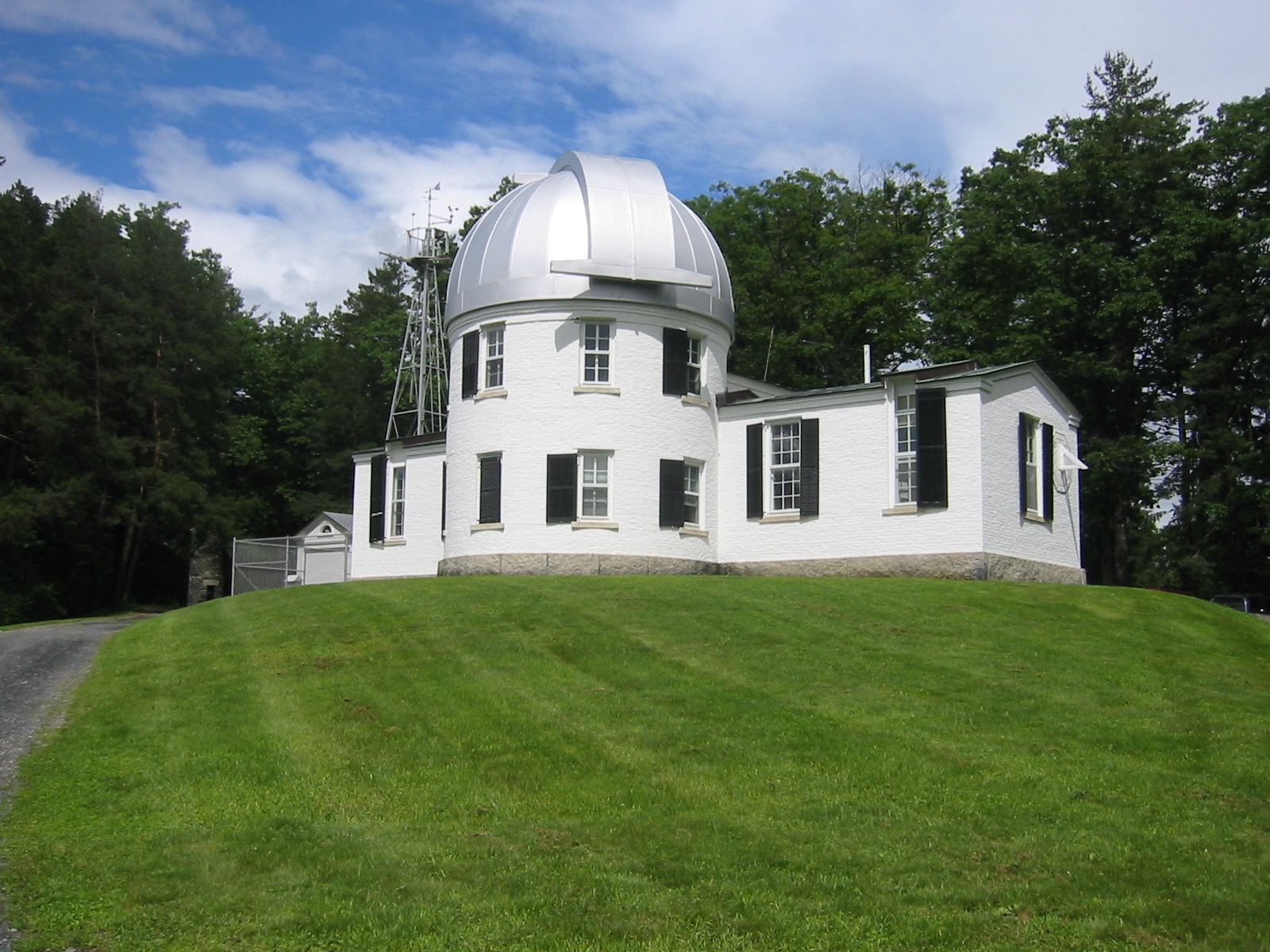
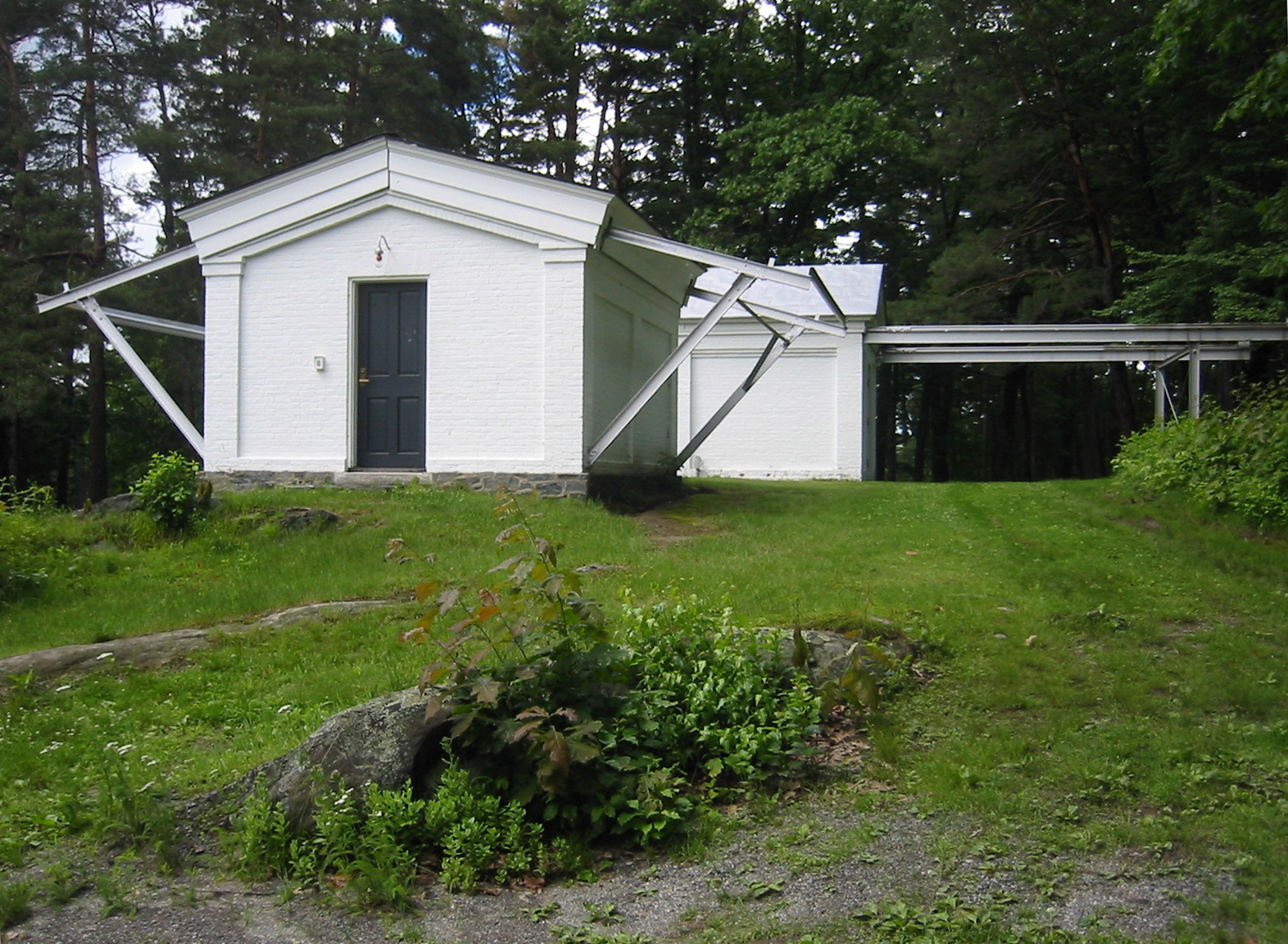
For some reason Wikipedia has been attributing the design of Shattuck Observatory to nineteenth-century Boston builder Gridley J.F. Bryant, at least in the article almost Bryant. That commodity also credited Bryant with the design of Dartmouth Hall, a misattribution that crept into the principal Wikipedia commodity near Dartmouth as well as an article in the Keene Sentinel.
The September xix alphabetic character from John Scherding to North Park Street neighbors 1 The letter of the alphabet is posted with the Valley News story. Dartmouth is treading lightly at present that the Boondocks has succeeded in stopping the Indoor Practice Facility. states that "if we determine to move forward, the Bema, Bartlett Tower, and the special character of the park would be preserved." The same phrase appears in the FAQ. What's missing? Shattuck Observatory.
In an interview with the Valley News, Rick Mills said "When you triage the things up there, the things that rise to the accented top are Bema and the Bartlett Tower." There is no mention of the historic observatory, designed past Ammi Burnham Young and built in 1854.
In the September 20 Dartmouth News story by Susan Boutwell, the Bema and Bartlett Tower are described in some detail, but Shattuck Observatory is not mentioned at all. The College Park projection folio has no mention of existing architectural resources — only "the distinct topography, ecology, and landscape" of the site. The map is described as showing "our residential neighbors and the natural spaces to exist preserved." Of course the map also shows Shattuck Observatory, just maybe it is not to exist preserved.
I needn't belong to the frozen-in-bister school to sense that Shattuck really should remain where it is. What if its telescopes are removed and it is surrounded past new dormitories? Fine — make Shattuck into the Professor's Business firm of this new Business firm Community. Turn it into a undercover society hall; put a couple of offices in in that location for grad students; but do not remove it. two Green Templeton College at Oxford (Wikipedia), founded in the late 20th century, occupies a slice of state that includes an quondam observatory, the Radcliffe Observatory. The observatory is used equally the college common room and serves as the architectural symbol of the college.
——————–
The college has hired Sasaki Assembly i If this complex is built, the college should go another firm to handle the design. Sasaki's Modernist college residential buildings look nice plenty (see Regis College and the N.C. State project folio and aerial) but they do not vest on this site. to come up with a conceptual design for a massive dormitory complex to exist shoehorned between the Wilder Lab and Shattuck Observatory, on the border of College Park (College Park Conceptual Pattern page, Dartmouth News article, Valley News article ).
The design brief calls for a chapters of 750 beds. That is more than twice the size of the East Wheelock Cluster (now East Wheelock Business firm), including the later McCulloch Hall:
| Andres Hall | 84 beds | |
| McCulloch Hall | 78 beds | |
| Morton Hall | 84 beds | |
| Zimmerman Hall | 86 beds 2 East Wheelock Firm site. | |
| Total | 336 beds |
One of the goals of the conceptual pattern procedure is to "respect the ridge." Keeping the buildings depression, especially at the upper end of the site, will require the college to use all of the buildable land inside the entire report expanse. This complex is likely to exist a Byker Wall (Wikipedia, Google aerial).
(To truly respect the ridge, of course, the college would have to stack all of this dormitory space into a tower sited behind Richardson Hall. That thought was raised and dropped in the 1960s. three As foreign as a dormitory belfry sounds in small-town New England, it was not too much for Bowdoin College (Google Street View). )
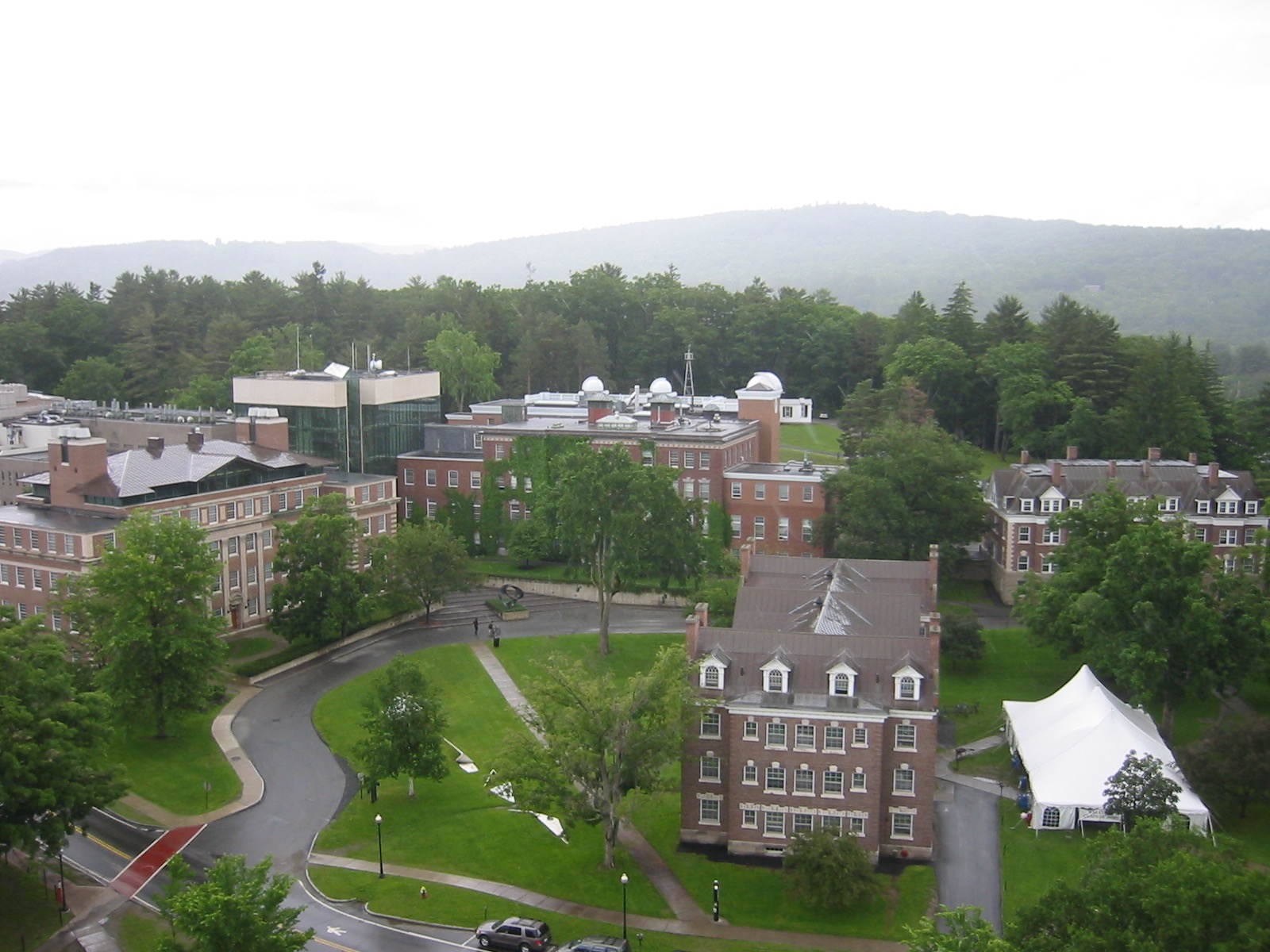
College Park has been encroached upon for decades and is significantly smaller at present than when it was created. The park could be a necessary building site some day, but the higher is certainly non there yet. (And construction costs will be higher than average here because of the limits on access, the necessity of protecting copse and historic buildings, and the fact that the whole site is made upward of ledges of bedrock: at that place will be a lot of dynamite required.)
This site was called because it is the only i that can concur all of the 750 beds the college believes to be necessary. The college could stand up to think more creatively — at that place are plenty of sites around campus where new beds could be built. There is space for hundreds of beds behind Mass Row and in front of Davis Varsity Firm, both sites that have been reserved for residential use for years. There is a site behind Fahey/McLane. Closer to Higher Park, Andres could be extended to the west. Ripley and Smith could be extended to the westward and east. Richardson Hall could stand up to have a rear ell added, incorporating an arched gateway to the park.
While a small building or improver at the bottom end of the College Park site would be a fine idea, a double-East Wheelock Cluster but is not appropriate here. One would honey to see the campus-wide primary planning iv Recently, Beyer Blinder Belle completed a main program for the campus and were brought dorsum to create a framework plan for the w end of Tuck Mall. Sasaki Associates were hired to plan out the Business firm Communities system and were brought back to design two temporary social buildings equally part of that organization. Some unreleased plan presumably shows Higher Park as the last large unused site on campus. Could information technology be that the planners are now rejecting the Mass Row and Davis Varsity sites because those sites are already reserved for the various permanent, on-campus professors' dwellings and social halls that the House Communities will need to exist fully realized? That plan would be an interesting one to come across. that led to the conclusion that a great wall of buildings on a cramped site of such sensitivity and meaning was the all-time movement to brand.
———————
-
The Moosilauke folio has a section called "Building has begun." Dartmouth News has a written report with some contempo photos showing the building taking shape. Trips this year will conclude at the McLane Family Lodge at the Skiway because the Ravine Lodge will not be fix.
-
Photos show the steel going up at the Hood Museum add-on; see also the Hood's updates on steel, progress, and the topping-out anniversary.
-
More twenty years ago an architecture magazine published a small photo of Spanish architect Ricardo Bofill's accommodation (cleverly invasive rehabilitation? creeping residential takeover?) of an old cement plant. The work has held a fascination ever since. Now Designboom has a comprehensive article. An amazing long-term project of simultaneously inhabiting a ruin and making a "ruin"; and don't those trees on the roof remind ane of J.1000. Gandy'south fantasy illustrations of Soane's Bank of England as a ruin?
-
A while back the absence of personality on the office of any of the new House Communities was noted. The apparently provisional names are withal in use, but the communities practice seem to be coming to life. Westward Firm (on the north side of Tuck Mall) has a blog with a bit of personality. For example: Westward House members are called Westians. The house has a Westletter and a team in the House volleyball league. West House has been using a logo that features an image of the great elm tree that stands between Fahey and Russell Sage. Incidentally, the borderline for House Community insignia design ideas was April 10. No word yet on results.
-
The Dartmouth says in an commodity that the higher is thinking of developing "a kind of 'village'" virtually the Bema in the College Park. One hopes that if it is built, it is sited at the n end or on the dorsum side of the park instead of about the Bema.
The College Park has been eyed as a building site for decades, virtually recently every bit a site for a pre-recession SLI "Commons Firm." There were some terrible ideas for building there in the Fifties and Sixties; and RipWoodSmith, later on all, is an inroad on the College Park, and Richardson was probably seen that way when it was built more than than a century ago.
-
U.Va. artisit-in-residence Marker Dion has created a "cabin of curiosities" downwardly the hill from the Architecture Schoolhouse. Interesting.
-
Heraldry news: Forth with renaming Calhoun College for Grace Hopper, Yale has given Hopper College a new coat of arms (Calhoun notice, Yale Daily News). Yale also built ii new residential colleges recently, Murray and Franklin. Rather than create stone Gothic buildings, the firm of Robert A.Thousand. Stern has designed a Tudorbethan circuitous of brick. The two colleges have had free coats of arms for a year or more (pdf). Finally, at Harvard, the sustainability website replaces the crimson of the school'south historic shield with a pea-soup green.
-
The Big Green Alarm Blog has a seating diagram showing Fenway Park as information technology will be configured for the Dartmouth v. Brown football game at that place on November ten.
-
The Medal of Honor Foundation is running elaborate eight-page print ads, such every bit those in Fortune Magazine, that attribute this quotation to Abraham Lincoln: "Any nation that does non honor its heroes will not long endure."

Actually? That certain does not sound like something Lincoln would say. Of course he used the phrase "can long endure" with reference to a nation in the Gettysburg Address, but that is all the more than reason to doubtfulness that this quote, similar and notwithstanding unlike, is also from him. And does it even brand sense? Isn't the maintenance of the military, or the food supply, or the economical might of the nation a bit more of import to the nation'southward survival than its treatment of its "heroes"? (And, objectively speaking, are they really heroes if they are not honored?)
The Grand Army of the Republic, which should know a Lincoln quote when it sees information technology, printed an article in 1909 (actually it was the GAR Department of Iowa in its Journal of Proceedings of the Annual Encampment) that contained this passage:
A human once said, "The nation which does not honor its heroes, itself should die. The nation which does not teach its children to laurels its heroes, itself will die."
No Lincoln. Someone asked the "Queries and Answers" column in the New York Times Review of Books in 1959 for the source of this statement: "A nation which does non honor its heroes shortly has no heroes to laurels." I am unable to detect a response.
-
Here'due south an idea: If Davis Varsity House needs to exist moved out of the way (see this snippet of the latest master programme), why not movement information technology to the intersection of Lebanese republic and Crosby Streets, a roundabout-worthy urban room that could exist called Larson Foursquare? Davis would occupy the parking lot adjacent to the Black VAC, a spot that is very close to the current location of Davis, fugitive a lot of big trees; and it fits perfectly with an intersection that is already home to 2 other major institutional buildings by Jens Larson.
-
Stained drinking glass, one-time and new.
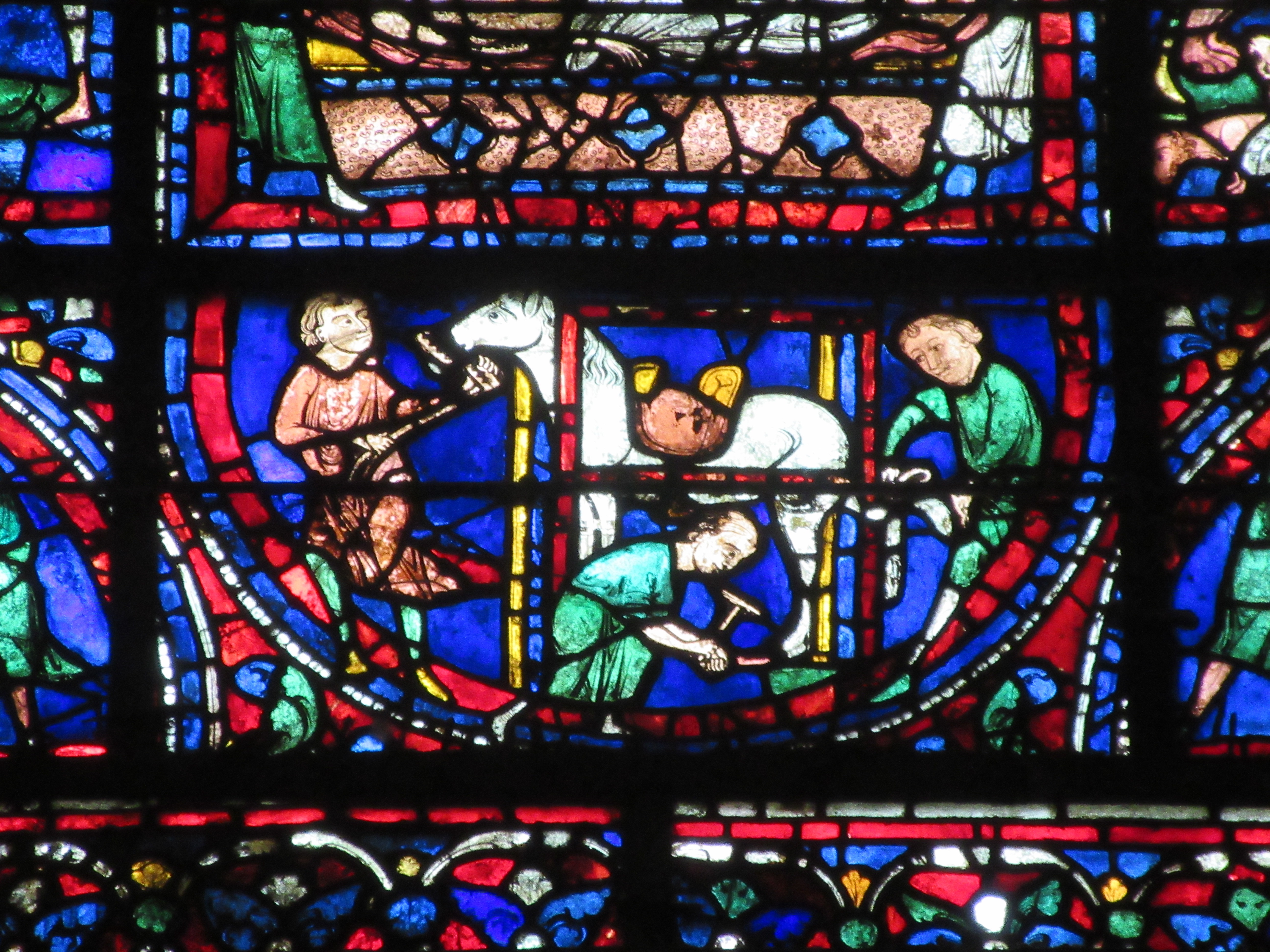
Signature panel, window in sixth bay, due north side of nave, Chartres. 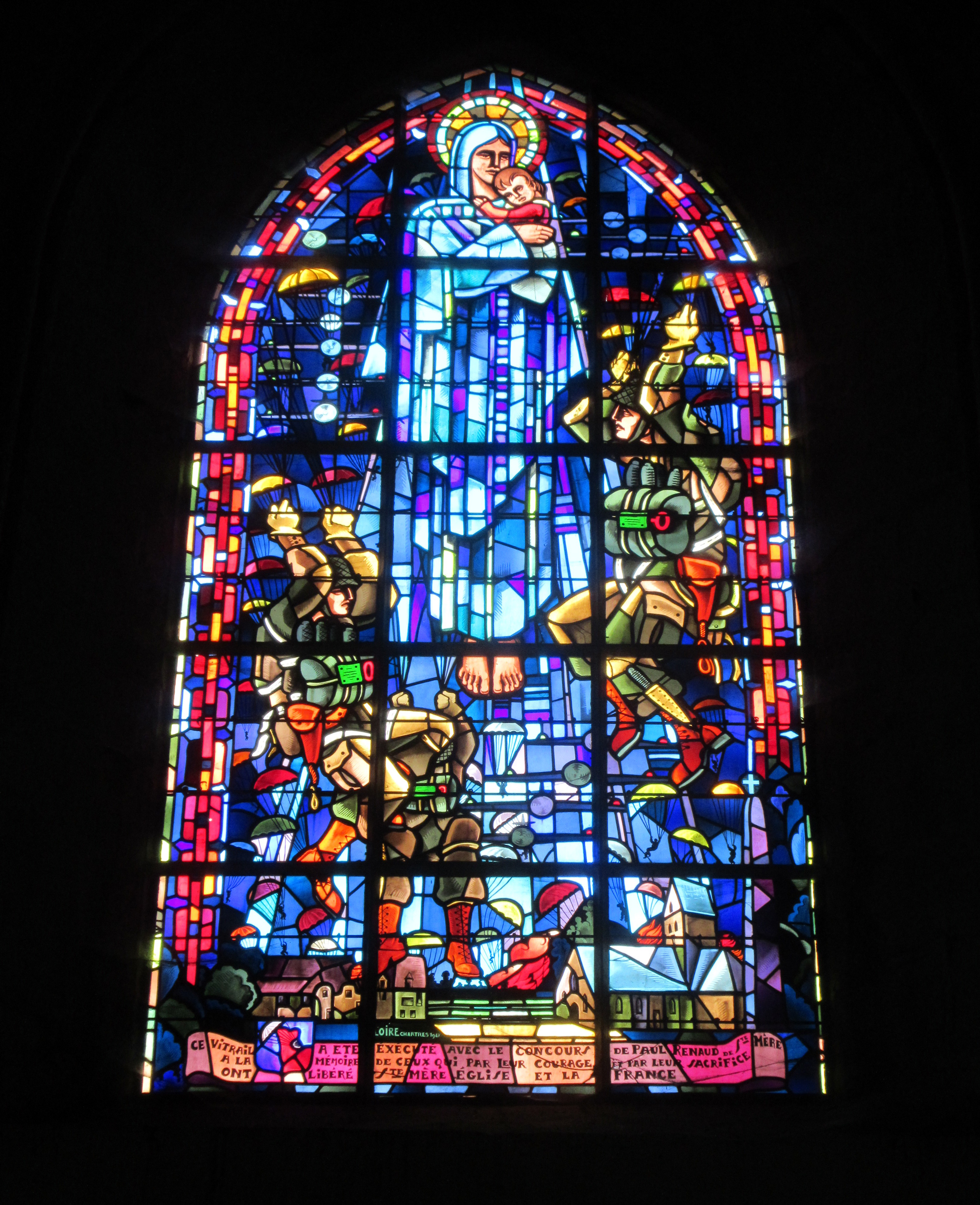
Window in south transept, Sainte-Mère-Église.
——
[Update 08.10.2017: Cleaved links to Hood photos removed, Lincoln quotation epitome added.]
Introduction
The college appear recently that it won't upgrade its Heating Plant from No. vi fuel oil to natural gas just will instead skip directly to a more than sustainable source of free energy. one Charlotte Albright, "President Hanlon: Big Green Will Go (More) Greenish," Dartmouth News (22 April 2017); Aimee Caruso, "Dartmouth Plans to Cut Oil Reliance," Valley News (23 April 2017). That energy source is probable to exist biomass. 2 Rob Wolfe, "New Dartmouth Task Strength Volition Help School Go Green," Valley News (31 August 2016); Peter Charalambous, "College to finalize heating and energy proposals," The Dartmouth (3 February 2017); Wolfe, "Fueling a Higher'southward Future," Valley News (27 April 2017). Because a biomass plant volition require a lot of land on which to shop piles of wood fries for combustion, the site of the current Heating Plant south of Wheelock Street volition non do. three Wolfe, "Fueling a Higher'due south Future."
The new plant
The higher is mum on where the new heating establish will exist congenital, but Dewey Field must be at the top of the list of possibilities. Dewey Field is a large, open site on Route 10 (Lyme Road) that is currently used every bit a parking lot. Well-nigh of the field is located outside the 10-infinitesimal walking radius that is supposed to define the limits of the campus proper. The field also is shut to the northern end of the tunnel network that currently carries steam lines to the diverse buildings. Some posts on this site have speculated almost the idea of putting a new heating plant in Dewey Field: here, hither, and especially here.
(Unfortunately for the college, Dewey Field is also close to the mansions of Rope Ferry Route. Would it exist possible to locate a biomass plant on the other side of Lyme Road, up by the Corey Ford Rugby Clubhouse? Or would the inefficiency created past the long altitude be too dandy?)
Wherever the school sites the new plant, information technology should be encouraged to hire an outside builder with vision. The northern gateway to Hanover is non the identify for a dark-brown, metallic-sided box. While the establish at Hotchkiss might not be correct for Hanover, information technology stands adjacent to a golf class. It was designed by Centerbrook with civil engineering by Milone & MacBroom, both firms that take worked at Dartmouth.
Since a heating plant is a simple industrial edifice, it tin can exist covered in annihilation. Hither is an amazing institute in the Netherlands that is clad in Delft tiles.
The old institute
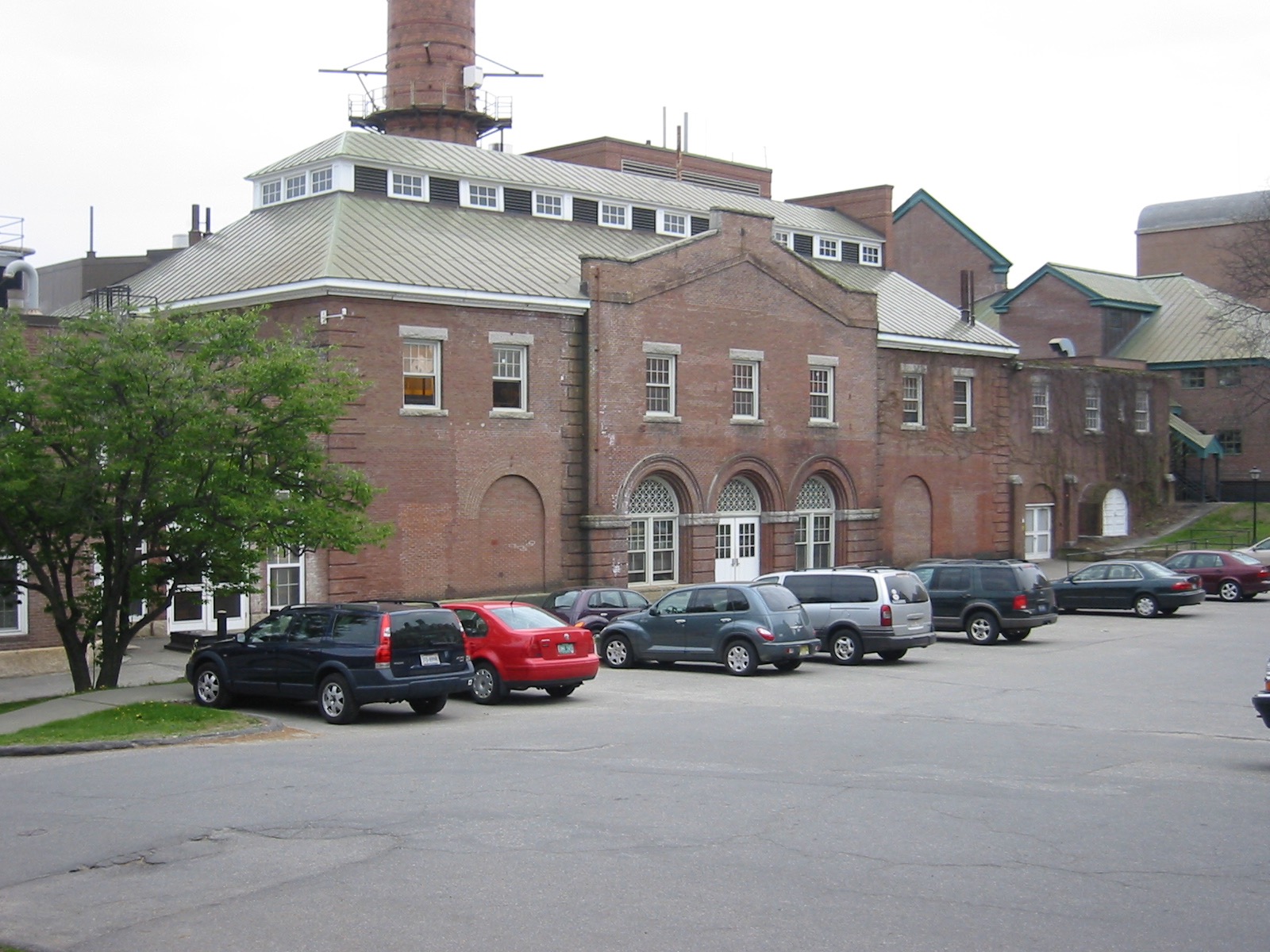
The sometime Heating Plant is one of the better examples of historic preservation at the college.
The ground level of the plant was built as a 1-story Romanesque building in 1898 (Lamb & Rich, Architects). The 2nd level was added by the college's other important architectural house, Larson & Wells, in 1923. In more than recent history, each fourth dimension the college has placed a new boiler in the edifice, it has dismantled a front facade bay and then congenital it back again — three times, in iii different bays.
This website cannot stop talking nigh the importance of preserving the old exhaust stack, a primal Hanover landmark — it is an axial terminus for Lebanon Street — and an historic symbol of the traditional function of this neighborhood equally Hanover's free energy commune. Yale's principal plan devotes one map to showing "major vertical objects," 4 Yale Main Plan pdf, 94. and this stack is 1 of the three most of import vertical objects in Hanover. It makes no difference that the stack, built in 1958, is non "original" to the building, whatever that means for this evolving industrial construction. The stack is just as well important. It satisfies the 50-yr threshold to exist considered "historic" under the Secretary of the Interior's Standards anyway. (And information technology goes without saying that Harry A. Wells's wonderfully adaptable 1916 Shop House on Crosby Street, seen in Google Street View, also must be retained.)
The old plant in the futurity
Erstwhile ability plants are reused all the time: see "Adaptive Reuse for Power Plants by Studio Gang and Adjaye Associates" 5 Aaron Wiener, "Adaptive Reuse for Ability Plants past Studio Gang and Adjaye Associates," Architect Mag (1 Dec 2013). and the Bruner/Cott renovation of Amherst'due south 1925 power business firm. The only natural motility would exist for the college to expand the Hood Museum into the empty institute building.
The old stack should get a victory cavalcade. Or the school could install a staircase and superlative the cavalcade with a Classical decorative element, such as the golden flaming urn of Wren's 1677 Monument to the Smashing Fire of London (Wikipedia) or William Whitfield'south 2003 Paternoster Square column, seen in Google Street View (that 1 was congenital as a ventilation shaft, Wikipedia notes). Or imagine commissioning a statue or an abstract sculpture as a new signpost for the arts at Dartmouth — and for the college as a whole.
-
David Kotz has some nice photos of the construction of the new Ravine Lodge.
-
The Rauner Library Blog has a post on the neat railroad artist Howard Fogg '38.
-
Spotted this flag at a Richmond, Virginia, expanse high school:

The star recalls the WWII Regular army Air Forcefulness insignia or the Chrysler Pentastar of the Eighties. Or it could be a battlefield map depicting a star fort surrounded by infantry units. The diverseness of bar widths is unusual. Flags of the World explains that it is "an official symbol of remembrance of September 11th" and that when it is hoisted vertically, the broad bars are meant to be seen as the Twin Towers.
Information technology turns out that the flag'south designer owns a restaurant very shut to the school, and that he has also designed a monument to the flag (in the shape of the flag, hoisted vertically) for a traffic island nearby. "Given that it is the home of the Freedom Flag, Henrico County is the natural choice for the location of the Liberty Flag Monument and Virginia nine/eleven Memorial."
-
Dartmouth At present seems to have changed its proper name to Dartmouth News.
-
Other higher buildings based on Independence Hall are establish at Brooklyn College:
and Westminster Choir College in Princeton, North.J. (see the Google Earth 3D image). -
Amherst has chosen equally its mascot the Mammoth. The blurb explaining the Mammoth proposal notes that "The Beneski Museum of Natural History famously displays the skeleton of a Columbian mammoth, unearthed by Professor Frederick Brewster Loomis and brought to the College in 1925." Museum specimens always provide good mascot options. Dartmouth'due south museum displayed both a stuffed zebra and a prepare of curious elephant (i.e. mammoth) bones during the late eighteenth century.
-
The University of Virginia is celebrating its 200th anniversary and will feature bicentennial-logo zipper pulls on this year'south graduation gowns.
-
The city of Krakow has a new logo in the form of a metropolis plan.
-
Last year the New York Times published interactive manufactures on mapping the shadows of New York and which existing Manhattan buildings could not be built today.
-
A Times obituary of March 13 noted the passing of the architectural historian and writer of the Streetscapes cavalcade Christopher Greyness. I was never able to run into him, simply I was honored to have my site mentioned in his column on Lamb & Rich, and I enjoyed visiting the Function for Metropolitan History to practise enquiry in his compilations of 19th-century Times edifice let notices (now they are in an online database provided by OMH, an astonishing resource). The New Yorker ran an commodity virtually how Gray had left his skeleton to his schoolhouse, St. Paul's. What a character —
Source: https://www.dartmo.com/archives/category/neighborhood-residential-colleges
0 Response to "What Are the Best Residential Houses at Dartmouth"
Post a Comment