Do Not Monetize or Upload to Spotify/itunes Etc. If You Havent Purchased the License.
A 2015 Berklee Higher of Music report found that anywhere from 20% to 50% of music royalties don't make it to their rightful owners. Kobalt calculated that in that location are over 900,000 royalty streams per song. How do you brand sure you annals your work properly and obtain all of the music streaming royalties that are rightfully owed to you? Keep reading. Every bit you lot report more well-nigh the global music rights, you'll run into the distinction over and over over again between "artist" and "songwriter." It's an important stardom to brand because the royalties for "artists" and the royalties for "songwriters" are completely different.
This is an excerpt from my book How to Make information technology in the New Music Business concern.
Ok, let'due south go.
The reason I'grand putting quotes around "artists" and "songwriters" is because so many of us are both. And many of us use these terms interchangeably. And back in the twenty-four hour period, when labels started signing artists who also wrote their own songs (which, at the time, was quite unique), they put in clauses in the contract to limit the royalties they'd (legally) take to pay out to their newly signed artists/songwriters. I of these clauses is the infamous controlled composition clause. The major labels have always tried to screw artists out their well deserved music royalties. They look out for their own best interests and use artists' ignorance (and bullheaded pursuit of fame) to manipulate and deceive. This is part of the reason why so many established artists and songwriters accept jumped ship from their major labels (and major publishers) and headed over to independent entities.
To not go into as well much history, and actually just cut to the chase, earlier the digital historic period, royalties were difficult to rail, but at that place were fewer platforms to consume music, so in that location were far fewer royalty streams to worry about. With physical sales plummeting, people shifting from downloading to streaming, and the rise of digital radio, there are many more royalties out at that place, only they tin can exist tracked much more easily.
Nosotros're non quite there yet, but we're getting closer every twenty-four hour period.
For indie artists without a label or a publisher, you accept to know what these royalties are and know where and how to get them.
So let's pause them down.
Start some terms y'all demand to understand:
Creative person
Artists tape audio recordings. Rihanna is an creative person. She did not write her vocal "Diamonds." So she is not the songwriter. Tape labels represent artists. A ring is an artist. A rapper is an artist. A singer is an creative person. Typically whatever proper noun is on the album is the artist.
Songwriter
Songwriters write the compositions. "Diamonds" was written by iv songwriters: Sia Furler, Benjamin Levin, Mikkel S. Eriksen, and Tor Erik Hermansen. Publishing companies stand for songwriters. A songwriter collects songwriter royalties.
Sound Recording
Some call this the "master." Information technology'due south the actual recording. The mastered track. Traditionally, labels (because they ain the master) collect music royalties for sound recordings. Sound recordings are non to be confused with compositions. Artists record sound recordings.
Composition
This is the song. Non the recording. Traditionally, publishing companies (because they own the limerick and represent songwriters) collect music royalties for compositions. Songwriters write compositions.
PRO
Performing Rights Organizations. In the Usa, these are ASCAP, BMI, SESAC and Global Music Rights (GMR). In Canada this is SOCAN. In the U.K. it's PRS. Pretty much every country in the world has its own PRO and they piece of work together to collect royalties from each other's territories. These performance rights organizations represent songwriters, not artists. These are organizations that collect performance royalties (not mechanical royalties—we'll get to those in a flake).
PROs make money to pay songwriter royalties and publishing royalties by collecting money from thousands of venues and outlets (radio stations, streaming services, TV stations, department stores, bars, alive venues, etc.) that accept been required to purchase "coating licenses" giving these outlets permission to play music in their institution (or on the air).
The PROs then puddle all of this money and split up information technology among all of their songwriters and publishers based on the frequency and "weight" of each vocal's "public performance." The PROs then pay the publishing companies their 50% and the songwriters their 50%. PROs carve up "publishing" and "songwriter" royalties every bit. 50/fifty. This is not a bargain you negotiate. This is but how they do it for anybody from Taylor Swift down to y'all and me. l/50. Any songwriter in the U.S. can sign up for ASCAP or BMI without beingness invited or having to apply. ASCAP and BMI are both not-for-profit organizations. SESAC and GMR are for-profit and you must be accepted.
ASCAP
American Guild of Composers, Authors and Publishers represents 700,000 members (songwriters and publishers) and over 10 million compositions. ASCAP is owned and run by its songwriter and publisher members, with a board elected by, and from, its membership. They accept paid out over a billion dollars in 2018. They represent songwriters similar Katy Perry, Dr. Dre, Marc Anthony, Chris Stapleton, Ne-Yo, Trisha Yearwood, Brandi Carlile, Lauryn Loma, Jimi Hendrix, Bill Withers, Carly Simon, Quincy Jones, Marvin Gaye, Stevie Wonder, Knuckles Ellington, annnnnd Ari Herstand.
BMI
Circulate Music, Inc. represents over 800,000 members (songwriters and publishers) and over 10.5 meg compositions. They stand for vocal-writers like Taylor Swift, Lil Wayne, Mariah Carey, John Legend, Lady Gaga, Eminem, (members of) Maroon 5, Michael Jackson, Linkin Park, Sam Cooke, Willie Nelson, Loretta Lynn, Dolly Parton, Fats Domino, Rihanna, John Williams and Danny Elfman.
SESAC
SESAC is non an acronym. Really. Information technology represents over 30,000 members (songwriters and publishers) and over 400,000 compositions. They represent songwriters like Bob Dylan, Neil Diamond, Blitz, Zac Brown, Hillary Scott of Lady Antebellum, the Avett Brothers, Shirley Caesar, Paul Shaffer and one-half of Thompson Square.
GMR
Global Music Rights (GMR) was founded in 2013 past industry legend Irving Azoff. Similar SESAC, information technology's invite-simply and for-profit. GMR pretty much exclusively represents superstars similar Bruno Mars, Bruce Springsteen, Drake, Don Henley, Glenn Frey and Joe Walsh (the Eagles), John Mayer, John Lennon, Smokey Robinson, Jon Bon Jovi, Prince, Slash, Leon Bridges, Ari Levine and Pharrell. They pride themselves on getting the most amount of coin for their very few clients. They take licensed over 33,000 songs with about 100 writers and 200 publishers on their roster.
Yous (as a songwriter) can't sign upwards to multiple performance rights organizations. Only sign up for one PRO. Yous have to brand distinctions and put ASCAP vs BMI for example, and choose which works for you.
Performance Rights Organizations in your land. Choice one and sign upwardly.
**It's important to note that if you get for an ASCAP membership every bit a songwriter, you besides need to annals a "vanity publishing visitor." That ways, just brand up a name (mine is Proud Honeybee Music) and register your publishing company with ASCAP. You lot must exercise this to get paid all of your music royalties. If you don't have your vanity publishing company registered as a corporation (like an LLC), or have a bank account under its name, make sure to tell ASCAP you are "doing business as" the vanity publishing company so they can write the checks accordingly. Yous tin also sign upwardly for direct deposit which expedites this entire process. ASCAP pays out l% of the full coin to the songwriter and 50% to the publisher. If you don't register a publishing company, you volition only get half of your money.
If y'all are an unaffiliated songwriter with BMI, you don't need to register a vanity publishing company. BMI will pay you lot 100% of the money.
HOWEVER, if y'all sign up for an admin publishing company (like Songtrust, Sentric, CD Babe Pro, or TuneCore Publishing), they will collect your publishing money from your PRO, take their commission (15-20%), and pay you out the residue. So, yous don't need to register a vanity publishing visitor (if you're with ASCAP) or annals it as an LLC or open up a bank account. This is a far easier option.
+Songwriters! Registering with ASCAP or BMI is Non Enough For You To Go Paid
I recommend y'all make sure all of your songs are registered with your local PRO and that y'all work with an admin publishing visitor. If you distribute through CD Baby, utilize CD Baby Pro. If you don't, utilise Songtrust, Sentric or TuneCore Publishing. If you lot haven't registered with a PRO even so, signup for an admin publishing company FIRST – they will then register your songs with a PRO (salve some time and steps!).
Digital Distribution Company
Some people call them digital aggregators. These companies are how you get your music into Spotify, Apple tree Music, Amazon, YouTube Music, Deezer, Tidal and eighty+ other digital stores and streaming services effectually the globe. I reviewed them in this piece.
+Best Music Distribution Companies – A Comprehensive Guide
HFA
Harry Fox Agency. Prior to Jan 2021 HFA handled U.S. mechanical royalties. Mechanical royalties are some other kind of songwriter royalty (total caption downwards a fleck more). HFA is now the organization that crunches the numbers for the streaming services so they know how much money was earned in mechanical royalties and and then pays that money to the MLC (in the United states of america) and to other Mechanical Licensing Organizations around the world.
The MLC now collects 100% of mechanical royalties from U.s.a. streams. This is by police.
The MLC
In early 2021, the Mechanical Licensing Collective formed. This was setup by the US government to collect mechanical royalties from streaming services in the US. The MLC is the only organization in the United states that collects mechanical royalties. The only way you can get these is if either y'all or your publisher is signed up with the MLC. You can register (and check on your songs) at themlc.com.
+The MLC Is Sitting on $423 Million. How Songwriters Tin can Claim It
Admin Publishing Companies
"Admin" stands for "administration." All publishing companies have an admin section. They too have a sync licensing department, an A&R department and many other departments. Admin publishing companies have started popping up over the by few years to aid unrepped songwriters (like you and me) collect all their music royalties from effectually the globe.
Again, companies like Songtrust, Sentric, CD Infant, TuneCore and Audiam are some admin publishing companies who will do this. These companies will accept anyone and everyone. If you lot have a bit more clout, you should look into more than exclusive companies similar Kobalt, PEN, Riptide and Secret Road. These companies operate like normal publishers, but work on an admin (commission only) basis. They exercise not retain ownership – like traditional publishing companies.
+Songtrust vs. Sentric vs. CD Babe Pro Publishing vs. Tunecore Publishing
Sync Licensing
"Sync" stands for "synchronization." A sync license is needed to sync music to picture. Idiot box shows, movies, commercials, video games, all need a sync license to legally put a song alongside their picture show. Technically, so does YouTube, Facebook and Instagram. YouTube, Facebook and Instagram officially struck deals with all the major (and most of the indie) publishers to officially allow cover videos on their platforms. That'due south why for a while, Facebook was ripping downward cover videos.
Back in the day, believe information technology or not, YouTube did information technology as well—per the publishers' request. But now that the platforms are licensed, publishers (and songwriters) tin can earn from cover videos on the platforms. YouTube was the offset, with their Content ID engineering, to exist able to runway and monetize songs uploaded by users on their platform. For verified partners, they will even carve up comprehend song earnings with the publishers and the creators of the videos.
+YouTube Content ID is a Scam
If y'all want to outset earning from your Facebook videos, sign up for Facebook for Creators. As of mid-2019, Facebook required creators to have at to the lowest degree 10,000 Page Likes, at least xxx,000 i-infinitesimal views in the by lx days, a Folio in proficient continuing, and to exist based in a country that is supported by Facebook monetization.
Sync Licensing Visitor / Agent
Sync licensing companies, sometimes referred to as sync agents, work to get your music placed in TV shows, movies, trailers, commercials and video games.
Sync licensing companies, frequently referred to as sync agents, typically simply represent artists who are also the sole songwriters. Sync agents are 1-stop shops for music supervisors. They want to make it as easy equally possible for the ad agency or TV show to apply the song. Licensing companies can clear the songs immediately for the music supervisors. Then if you cowrite with anyone, showtime make sure they are not signed to a publishing visitor (if they are, information technology makes things very difficult and will well-nigh certainly forbid a sync agent from working with you or repping that song). And make sure you get in writing (e-mail is fine), that you have full rights to the vocal to license without getting permission from your cowriters.
Give-and-take TO THE WISE: Never pay a sync agent coin up front to go pitch y'all. If they believe in your music, they will pitch you and work solely on committee. Commissions are typically between 25% and 50% of the upwards-front fee. Some will have a commission of your backend PRO royalties and some will not.
If you lot want to learn how to go your music synced and get a full list of reputable sync agencies, bring together Ari's Have University'southward course: Advanced Sync Strategies for Film, TV Shows and Video Games
Also, there are music licensing companies and libraries (like Triple Scoop Music, Audiosocket and Musicbed) that specialize in issuing cheap sync licenses for hymeneals photographers, corporations (for in house training videos) and indie filmmakers. This tin help you lot bring in some extra dough. These kinds of companies are definitely worth looking into. They don't work to get you the $200,000 Verizon commercial spot, they're soliciting wedding photographers to pay $sixty to license your song in their personal utilize wedding ceremony video. Merely these tin add up. There are a agglomeration of these music licensing companies and libraries out there.
Just Google around a scrap – effort "music for wedding video" or "license music for indie film" or "license music library" and these companies volition populate. Nearly are quite selective virtually what songs they bring on (to continue their quality up). Simply they all take applications from unknowns. If the quality is there (and information technology fits their format – they're probably not going to take death metallic or gansta rap for a wedding video licensing business). Well-nigh are non-sectional, meaning you tin work with a bunch of them.
Once again, Exercise NOT pay annihilation up front. If any visitor charges you upwardly front for these services information technology'southward a scam. Run abroad (to this comment department and let u.s. know who these scam artists are)!
+How To Get Songs on Television set, Film and Video Games (and get paid for information technology)
SoundExchange
A lot of people confuse SoundExchange with PROs because technically SoundExchange is a performing rights system. But I'm not including them in the "PRO" classification out of clarity (and when most in the biz discuss PROs, they are simply referring to the aforementioned ASCAP, BMI, SESAC, SOCAN).
SoundExchange represents artists and labels whereas (the other) PROs stand for songwriters and publishers. Unlike the four PROs in America, SoundExchange is the only organization in America that collects performance royalties for "noninteractive" digital sound recordings (not compositions). "Noninteractive" ways you can't choose your song. And then, SiriusXM radio is noninteractive, whereas Apple tree Music and Spotify are "interactive." Beats1 (within Apple Music) is digital radio (noninteractive). Function of Pandora is still noninteractive as well.
SoundExchange has agreements with xx foreign collection agencies. When your music is played in their territory, they pay SoundExchange, and SoundExchange pays you. Like the PROs, SoundExchange issues coating licenses to digital radio (noninteractive) platforms (like Pandora and SiriusXM) which gives these outlets the ability to play any song they represent. Like the PROs, the outlets pay an annual fee for the blanket license. But, SoundExchange collects merely digital royalties. The PROs collect digital, terrestrial (AM and FM radio) and live royalties.The way the copyright police force is currently written in the Us, AM/FM radio has to pay only limerick performance royalties and non sound-recording royalties. Makes no sense.
The U.S. Copyright Role has recommended that this police be changed, just simply Congress tin practise that, and the few times it has tried, the proposal was defeated, largely as the result of heavy lobbying past Big Radio.
And then, over again, SoundExchange = digital audio-recording royalties for noninteractive plays in the U.Due south.
And to complicate matters even more, not all digital radio services work with SoundExchange (merely 2,500 do). Some opt out (Spotify noninteractive radio has opted out) and they just negotiate rates straight with each label/distributor.
How To Sign Upwards For SoundExchange or Your Land'due south Neighbouring Rights Organisation
If you are a U.S.-based artist, get to SoundExchange.com. If you are both the performer (artist) and the owner of the sound recording (significant you don't accept a record label), simply select "Both" on the second page of the registration when it asks you to select: Performer, Audio Recording Copyright Owner or Both. It's a long process and y'all have to submit a full catalog list. When I did this, I had to email in a complicated Excel doc with lots of info. Program a weekend to practice all of this. It's time-consuming, but worth it.
—> If you are NOT in the United States you do NOT need to sign upward for SoundExchange. Signup for your country'due south "Neighbouring Rights Organization" – see beneath
Fun fact: I encouraged Ari's Accept reader and children's musician Andy Mason to sign upward for SoundExchange, and the first cheque he got was for $14,000! Apparently, Pandora had his songs included on all the most popular children'southward music radio stations and he had no idea. Smash! SoundExchange will hold your dorsum royalties for three years, so register now if you lot haven't already. And if you lot accept registered (maybe y'all did years agone), brand sure yous take also registered equally the Audio Recording Copyright Owner (they previously called it "Rights Possessor"). Because the "Both" option is very new, you may have missed it and are only receiving 45% of your total money.
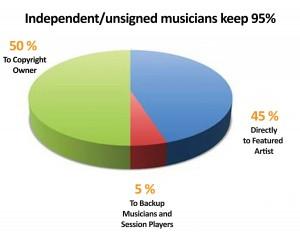
Why 45% and not 50%? Session musicians tin get some of this money too! If you are a session musician, five% of the total coin earned for each song has been reserved for you. Contact the AFM (the musician's wedlock) to take hold of this moola.
SoundExchange's breakup for payment: 45% to featured artist, 50% to the sound recording owner (characterization—or y'all if y'all cocky-released), and 5% to session musicians or, every bit they put it, "not-featured artists."
Whether you have session musicians or not on your record, SoundExchange withholds v% of all royalties from everyone for them. If you live outside the United states of america, you do not need to sign upward for SoundExchange. You should register with your country'south neighbouring rights organisation. What is that? Keep reading. So, but to analyze, hither is a breakdown for the music royalties artists and labels earn (and how to get them):
Backup Musicians and Session Players
If yous played on a tape as a session musician and that tape was released by a label registered with AFM & SAG-AFTRA, you are entitled to various royalties (not just from SoundExchange). It's definitely worth checking the AFM & SAG-AFTRA Fund website to see if you accept outstanding royalties.
Neighbouring Rights
In nearly every land exterior the U.s.a., there'southward what'due south called "neighbouring rights." Yep, if this was an American thing, it would be spelled "neighboring," only information technology's not. It's European and beyond. Neighbouring rights are similar to what SoundExchange administers and collects (audio recording functioning royalties for artists and labels); however, they too collect royalties from music played on terrestrial radio, television, in bars, jukeboxes and everywhere else in the physical world. In the U.K., the organization that does this is PPL. In Canada this is Re:Audio. Just search "Neighbouring Rights (Your Land)" to find how to collect your music royalties in your country. For clarity, if you live exterior the U.S., y'all do non need to register with SoundExchange. Annals with your land's neighbouring rights organization to collect audio recording performance royalties.
Nearly every neighbouring rights organization works with SoundExchange to collect U.S. royalties.
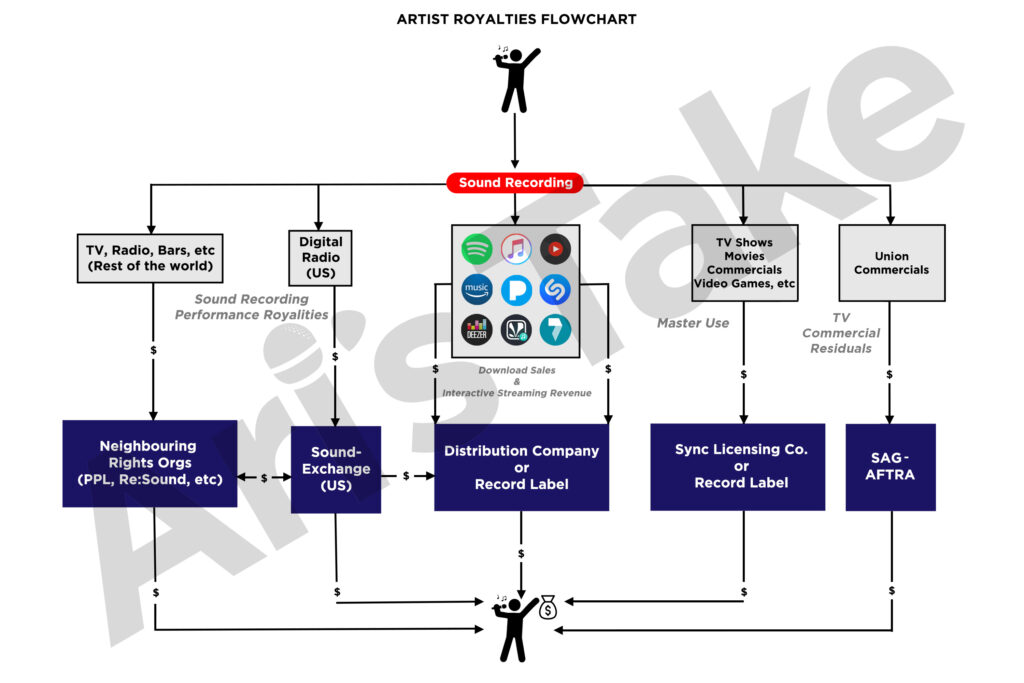
Artist Royalties
The Best Road for Maximum Music Royalties (for you)
ASCAP vs BMI
When we pit ASCAP vs BMI, they both hold similar numbers in terms of members and compositions. That also rings true in terms of performance royalties payouts and other features. For example, they both make quarterly payments to writers and both are affiliated with a good amount of other services and companies. But when it comes to memberships, ASCAP will set you back $50 annually, whereas BMI will lock you in for ii years without a fee.
The ASCAP membership toll is probably the only reason anyone would turn away from this PRO. In the business since 1914, ASCAP knows their way around the manufacture and their intuitive website is loved by their members.
ASCAP or BMI for Independent Artists
Although a BMI membership is free, it's not the only reason they're chosen by independent artists. BMI vs ASCAP is as well close of a match and fifty-fifty though they're non the oldest in the game, they're definitely known a very respectable and good choice for a PRO.
Creative person Royalties
Audio Recording Digital Performance Royalties
In the United States, these are just from non-interactive digital streaming services, also known as digital radio. Outside the U.S., these are from radio (digital and terrestrial), TV, jukeboxes, bars, cafes, shops, dark clubs, gyms, universities, and anywhere there is a "public performance" of a recording called digital performance royalties.
How to Go Paid: SoundExchange in the U.S., PPL in the U.K., Re:Sound in Canada, or your country's neighbouring rights organization.
+Annals for SoundExchange here.
Download Sales
These outcome from someone downloading your music on iTunes, Google Play, Amazon, etc.
How To Get Paid: Your distribution company. Think, if a fan downloads your music on Bandcamp, you get a check direct from Bandcamp considering Bandcamp is a self-managed (as in y'all manage it yourself ) store.
+All-time Music Distribution Companies – A Comprehensive Guide
Interactive Streaming Acquirement
There are lots of different kinds of streaming acquirement. But interactive (meaning yous choose the vocal) streaming revenue (like from Spotify, Apple Music, Deezer, Tidal) goes to the artist/label. When these services claim they pay out 70% of all revenue, the 70% is for both the artist/label revenue and the songwriter royalties (mechanical royalties and performance royalties). Streaming revenue to artists is way more than the mechanicals royalties paid to songwriters.
How to Get Paid: Your distribution company
+How to get 100 million Spotify streams without playlists
YouTube Sound Recording Revenue
Technically there are a agglomeration of "avails" (streams of acquirement) for each video. To make information technology simple, we'll only get into how you lot can earn money. First, for the sound recording (we'll get into the composition in the adjacent section). Yous tin make music royalties off of any video that uses your audio recording (whether you uploaded the video or not) if you let YouTube and Facebook to put ads on the video (they phone call it "monetize"). Either videos you upload or fan-made cat videos with your sound recordings can generate advert revenue that y'all can collect if you are a verified partner. YouTube splits the ad revenue 45%/55% in your favor. Facebook (and Instagram) have not publicly discussed their rates.
How to Get Paid: Most digital distribution companies take this option via an opt-in checkbox. If your benefactor doesn't handle this, you tin piece of work directly with YouTube to become a verified partner or sign upwards for an independent revenue collection company similar Audiam and AdRev. But it's easiest if you continue everything under 1 roof.
Primary Employ License
Any TV show, movie, commercial, trailer or video game requires both a master use license (from the creative person/label) for use of the sound recording and a sync license (from the songwriter/publisher) for use of the limerick. These days, most music supervisors (the people who identify the music), will just pay you (an indie artist) a bulk amount for both the primary apply license and the sync license (because nearly indie artists wrote and recorded the song).
Just if you're repped by a characterization and a publisher, the supe (that's brusque for music supervisor) volition go to your label and pay for a master utilise license and and so to your publisher and pay for a sync license. Usually information technology's the same amount, but not always.
How to Become Paid: Directly from the TV studio, advert agency (for a commercial), production visitor (for a picture or trailer) or game company. It's best to work with a sync license agent for this.
TV Commercial Residuals
If your music (with vocals) gets on a SAG-AFTRA union commercial you can also earn these royalties. And these definitely add upwards. I was in a Bud Low-cal commercial (as an player), and in SAG-AFTRA residuals, I got about $10,000 a month for the elapsing it was on the air. That was for hanging out at a (faux) barbecue property a tin can of Lime-A-Rita and laughing on cue a lot. If one of your recordings with vocals gets into a union commercial, you might make something similar that. Many commercials run nearly six months, that could be $60,000 just in SAG-AFTRA residuals. When getting a vocal synced on a commercial, make sure you always enquire if it is a SAG-AFTRA commercial so you tin call up SAG-AFTRA and go these music royalties.
How to get paid: SAG-AFTRA
If, yet, SAG-AFTRA doesn't accept your mailing accost, they won't know who to pay. Contact SAG-AFTRA directly and give them your info when you lot have a recording played on a Telly commercial. Worth mentioning, y'all exercise not demand to be a SAG-AFTRA member to go paid.
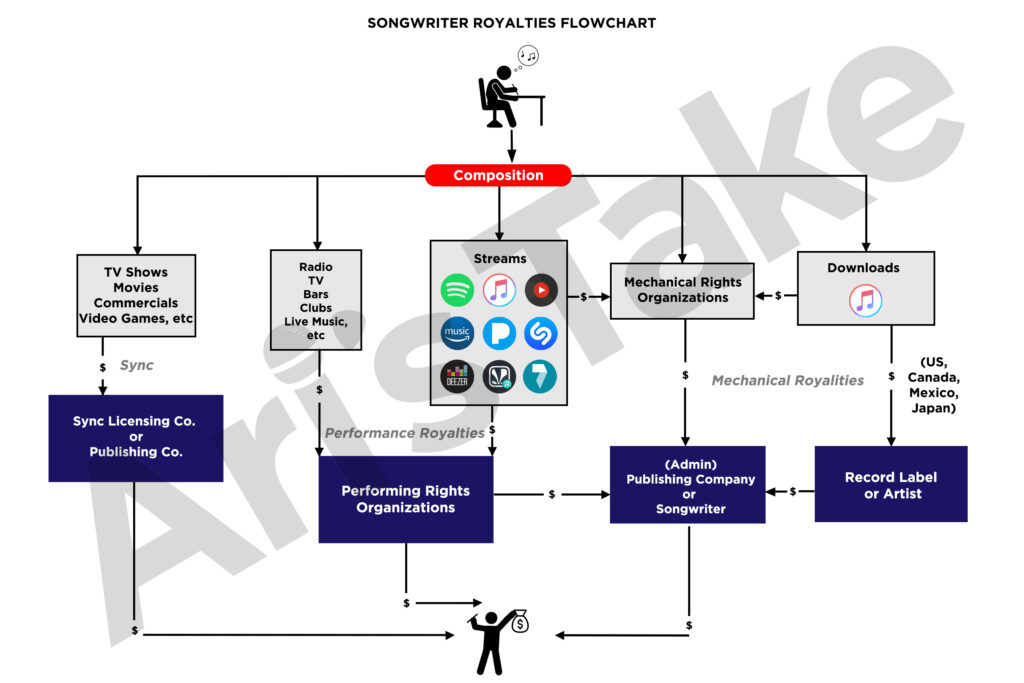
Songwriter Royalties
Songwriter Royalties
Composition Operation Royalties
Performance royalties come up from plays on the radio (AM/FM or digital), interactive and noninteractive streaming services (Spotify, Apple tree Music, Deezer, Pandora, YouTube Music, Amazon), live at a concert (aye, fifty-fifty your own), in restaurants, confined, section stores, java shops, Television set. Literally any public place that has music (live or recorded) needs a license from a PRO to exist able to legally play music in their establishment. For some reason, American picture theaters are exempt from needing a public functioning license for the music used in films, and no ane gets paid residuals when songs are played in the films. Music played in movie theater lobbies and bathrooms is different and tin can be licensed (and earned on). When a movie is played on Idiot box, the songs in that movie earn royalties. When that same picture show is played in a picture palace, those songs exercise non earn royalties. Makes no sense. Information technology's just the way it is.
All the same, functioning royalties are generated for movie theaters outside the U.S. And for an international smash, it could add up to exist some serious cheddar. I've heard of amounts in the hundreds of thousands of dollars. Not yen. Dollars, baby!
Of course if a coffee shop has the AM/FM radio playing, and if you're with ASCAP music, you (most likely) won't get paid when your vocal is played there, because ASCAP most likely won't exist conducting a survey of that radio station at that exact moment, but if the shop has Pandora or SiriusXM on (or other piped-in Muzak services), this is tracked and you will (eventually) get paid on the plays.
The system is currently being worked out and not everything is tracked however, but eventually, say, in a few years, it will be. ASCAP uses a "sampling" method, where they employ an electronic monitoring system, MediaMonitors/MediaBase, for sample performance information from commercial, public, satellite and college radio. The sample information is then loaded into ASCAP's Audio Performance Management arrangement where it is (mostly) electronically matched to the works in the ASCAP music database.
ASCAP states that they supplement this data with station logs and other technology vendors and methods that capture ads, promos and themes, and background music. BMI also uses sampling. They say they use "performance monitoring data, continuously nerveless on a large percent of all licensed commercial radio stations, to determine payable performances." They also utilize their "proprietary design-recognition engineering science." They call information technology a "demography" and claim information technology's "statistically reliable and highly authentic."
My song was played every bit bridge music on NPR's All Things Considered (for thirteen one thousand thousand people). I won't be getting paid for this (unless ASCAP happened to exist running a sample of NPR at that exact moment).
Tip: Virtually PROs (like ASCAP, BMI, SOCAN, PRS, etc.) have a programme where you can import your setlist and venue information to secure payment of your live functioning royalties (for performing your originals in a guild, theater, grocery store, arena, wherever). This tin can actually be a pretty proficient chunk of change. In the U.1000., for instance, PRS calculates this as £10 per prove for non-ticketed gigs (similar cafes and pubs) or at least iv% of box office sales for ticketed venues (any size from clubs to arenas). The iv% is then divided among all of the songs performed at that venue that year separate between headliners (80%) and openers (20%). I recently heard that an opener of a big arena bout in Europe playing just four songs a night was making nigh £ix,000 (almost $eleven,000) per night in performance royalties!
And so it'southward super of import that yous register your setlists with your PRO. Some admin publishing companies (like Sentric) volition register your setlists with the PROs in the regions you tour—but you must enquire nigh this. Many PROs, however, require the artist to input their setlists direct. ASCAP too runs a split up survey of the 300 elevation-grossing tours of each twelvemonth, according to Pollstar. This includes both headliners and openers' set lists.
How to Get Paid: Your PRO
+From $0 to $4K a Month Livestreaming
Mechanical Royalties
Mechanical royalties are earned when a vocal is streamed, downloaded or purchased (like a CD or vinyl). In America, the charge per unit is set by the U.S. government. In the US, streaming mechanicals from every DSP are paid directly to the MLC. What's the MLC? It'southward the Mechanical Licensing Commonage created in early on 2021.
And in 2018, the rate increased (for the starting time fourth dimension in many, many years)!
Worth noting, in the Us, Canada and Mexico mechanical royalties get passed on to the label/distributor from iTunes; however, about everywhere else in the world, mechanicals get collected past local collections agencies before the money gets to your benefactor. That's why when yous look at your statements, an iTunes download in the U.S. nets you lot $.69 (70% of $.99—Apple retains 30% from iTunes sales) whereas a download in England nets y'all around $.lx.
So if you lot don't have an admin publishing company, yous won't get any of your international mechanical royalties from download sales (but who downloads music anymore?!). Most international drove agencies will hold on to this money (for most three years) until a publisher comes and claims it. You technically could try to do this by calling up collection agencies in every country, but I just recommend going with an admin pub company—they already have all the relationships congenital (and they merely accept near 15%–25%; it'due south worth it).
How to Get Paid: Admin publishing company, the MLC (in the US) or your state'due south mechanical rights arrangement.
+Songtrust vs. Sentric vs. CD Baby Publishing vs. TuneCore Publishing
Sync License
Like the master use license, any Goggle box show, movie, commercial or video game requires a synchronization (sync license for short) license to put the com-position aslope their picture.
How to Get Paid: Directly from the TV studio, ad agency (for a commercial), production company (for a picture show or trailer), or game visitor. Information technology's best to work with a sync licensing visitor for this.
+How To Go Songs on Television set, Film and Video Games (and get paid for it)
How to Release Cover Songs (Legally)
If yous want to release a cover vocal (remember, vocal, not video), you take to become a mechanical license. The U.S. constabulary states that once the song has been publicly released, anyone can cover information technology, without permission from the copyright owner as long as they become a compulsory mechanical license for the song. Sounds scary and complicated, but information technology's actually quite simple. Your digital distribution company may handle this for you. But if they don't, you have to go a license via HFA's Songfile or Piece of cake Song Licensing.
+How To Legally Release Cover Songs (with images)
Yous made it! Come across? I told you you could do information technology. You're now a music royalties master. Now become brainwash all of your musician friends. Ok, yeah, that was a helluva lot of information. Bookmark this folio so you tin reference information technology. And brand sure to signup for my electronic mail list below to get more tips like this to your inbox.
Frequently Asked Questions
What is ASCAP?
ASCAP is a community of songwriters, composers, and music publishers. A functioning rights system that'due south run by its members. They provide music licenses to businesses to allow them to use the music publicly and provides music royalties to its members from that revenue.
Which Song Has Made the Well-nigh in Royalties?
You lot may have guessed information technology – it'south the "Happy Altogether" vocal by The Hill Sisters (1893). The rights to the song was bought past Warner Chappell for $xv one thousand thousand, and to this day brings in an almanac $2 1000000 dollars in music royalties.
What Are Royalties in Music?
Songwriters, artists, composers, and representatives receive music royalties from other companies or establishments that want to play their music publicly. It's a form of compensation for a license that allows public use of the media and ensures everyone receives what should exist a fair share of the income.
What is PRS?
PRS stands for the Performing Right Society. If y'all're request 'what is PRS?', so in that location's a lot you lot need to know nearly music royalties to ensure you e'er go your off-white share. When your piece of work gets broadcasted on Boob tube, in public, on the radio, or elsewhere, the Performing Right Society (PRS) and the Mechanical Copyright Protection Guild (MCPS) pay royalties to their members.
What Does SESAC Stand up For?
If you find yourself invited to bring together SESAC, you may be wondering 'What does SESAC stand for anyway?' – well, first of all permit me congratulate you on your invitation! 2d, SESAC is an acronym for the Order of European Stage Authors and Composers. SESAC collects music royalties from different avenues and is considered a leader in the space.
SoundExchange vs BMI – Which Ane Should I Choose?
SoundExchange and BMI are both PROs that collect performance royalties for public performances. Yous need both to maximize your songwriter royalties. SoundExchange vs BMI is the same every bit digital vs live/public. For Pandora, SiriusXM, and other not-interactive mediums, SoundExchange is needed to collect songwriter royalties from them. Whereas BMI will collect royalties for public performances such equally radio or restaurants.
Why Choose BMI Publishing?
To be clear: BMI is not a publisher. BMI is a performing rights organization (PRO). Y'all can annals your vanity publishing company with BMI then you take a publisher, so to speak. You tin can register for BMI for free, whereas ASCAP charges a fee of $fifty. I spoke most the similarities and differences for ASCAP, BMI, and SESAC earlier in this commodity.
How to go a paid songwriter and earn vocal royalties?
When you start looking into how to become a paid songwriter, you'll chop-chop realize that earning song royalties isn't a become rich quick scheme, or an easy road to fame. Hard work is synonymous with songwriting and it volition take tons of work, practice, working with others, and persistence. Oh, and make sure all of your sounds are copyrighted and registered properly then you can start collecting your royalty checks (that'southward why you're here!).
Sign up to my email list and I'll ship you the 26 things to practice earlier you release your song or album.
How practise songwriting royalties work?
There are three ways to earn songwriting royalties. Functioning royalties, mechanical royalties, synch fees, and publishing royalties. Mechanical royalties refer to digital downloads at 9.ane cents carve up between co-writers and publishers. Performance royalties are for live/public/broadcasted performances paid out through Performing Rights Organizations (PROs). A sync fee is received by a songwriter (and/or publisher) when a TV show, advertisement agency, production house, or company purchases a sync license to apply a piece of piece of work to synchronize with video.
Any Questions?
Ask me annihilation about music royalties and how yous tin go your fair share.
Source: https://aristake.com/what-is-soundexchange-ascap-bmi-pros-hfa-mechanicals-and-how-to-get-all-your-royalties/
0 Response to "Do Not Monetize or Upload to Spotify/itunes Etc. If You Havent Purchased the License."
Post a Comment